
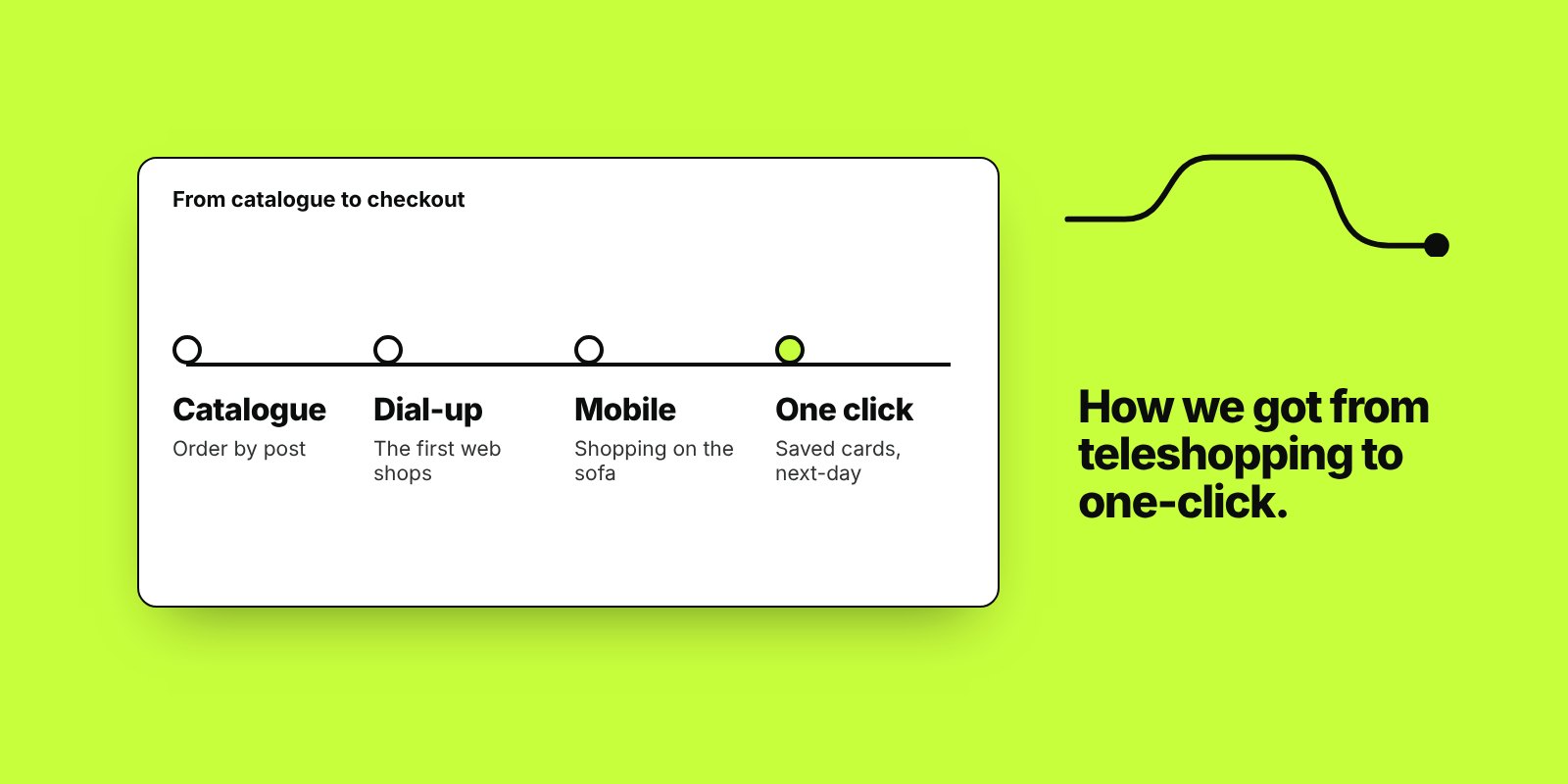
The short version
- Online shopping is older than the web. Michael Aldrich demonstrated “teleshopping” in England in 1979, and in 1984 a Gateshead pensioner ordered her groceries from Tesco through her television.
- The web became public in 1991, and browser encryption in the mid-1990s made paying by card online practical. Amazon and eBay both launched in 1995.
- The dot-com crash of 2000 and 2001 took down many online retailers, including London’s Boo.com. The survivors had customers who came back and a route to profit.
- Smartphones, starting with the iPhone in 2007, moved shopping onto the phone, and the 2020 lockdowns pushed the online share of UK retail sharply higher.
Online shopping started earlier than most people think. The first systems ran over telephone lines and television sets years before the web existed, and some of the earliest trials happened in Britain.
This is a short history of how it got from there to the phone in your pocket, using dates that are well documented, followed by what the story suggests for anyone running an online shop today.
Before the web: teleshopping in the 1970s and 1980s
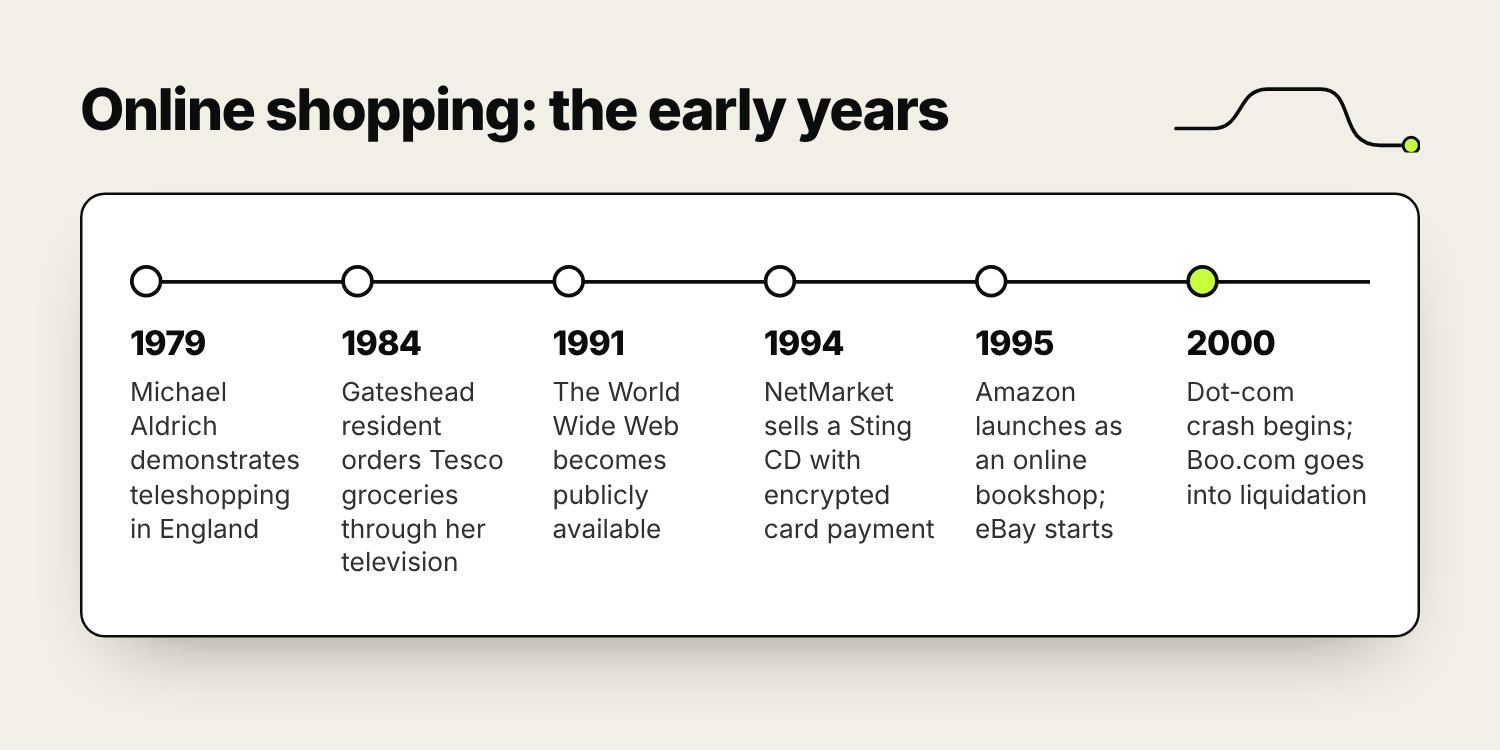
In 1979 Michael Aldrich, an English inventor, demonstrated a system that linked a modified domestic television to a computer over a telephone line, so that orders could be placed from home. He called it teleshopping, and it’s often described as the first online shopping system.
The best-known early test of home shopping by screen took place in Gateshead. In 1984, as part of a local scheme to help older and housebound residents, Jane Snowball used her television and remote control to order groceries from her local Tesco, which were then delivered to her door.
Across the Channel, France’s Minitel put terminals connected to the phone line into millions of homes from the early 1980s, used for directories, bookings and orders.
These systems worked, but each was a closed network. You could only buy from businesses that had joined that particular system.
The web and the first secure payments
Tim Berners-Lee proposed the World Wide Web at CERN in 1989, and it became publicly available in 1991. For the first time, any business could put a shop online that anyone with a browser could visit.
Paying was the problem. Sending card details across an open network wasn’t safe until browsers added encryption. Netscape developed SSL, the forerunner of the TLS encryption behind the padlock in today’s browsers, in the mid-1990s and built it into its Navigator browser.
In August 1994 a US start-up called NetMarket sold a copy of Sting’s album Ten Summoner’s Tales to a customer who paid by card over an encrypted connection. It’s widely cited as the first secure online retail purchase. There are earlier stories, including students arranging a sale over ARPANET, the forerunner of the internet, in the early 1970s, but no payment was made online.
In 1995 Jeff Bezos, who had founded Amazon the year before, launched it as an online bookshop, and Pierre Omidyar started the auction site that became eBay.
The dot-com boom and crash
In the late 1990s investors poured money into internet companies, often on the strength of visitor numbers rather than profits. In China, Jack Ma founded Alibaba in 1999, starting with a marketplace that connected manufacturers with buyers overseas.
The Nasdaq, the US stock index where most technology companies were listed, peaked in March 2000 and fell steeply over the next two years. Online retailers were among the most visible failures. Boo.com, a London-based online fashion retailer, launched in 1999 with an ambitious and expensive website and went into liquidation in May 2000. In the US, Pets.com closed in late 2000, and the grocery delivery company Webvan went bankrupt in 2001.
The companies that came through, Amazon and eBay among them, had built businesses customers returned to and that could eventually make money. Several ideas that failed at the time, including online grocery and pet supplies, worked later once broadband, smartphones and better delivery networks caught up.
Search, payments and shop platforms in the 2000s
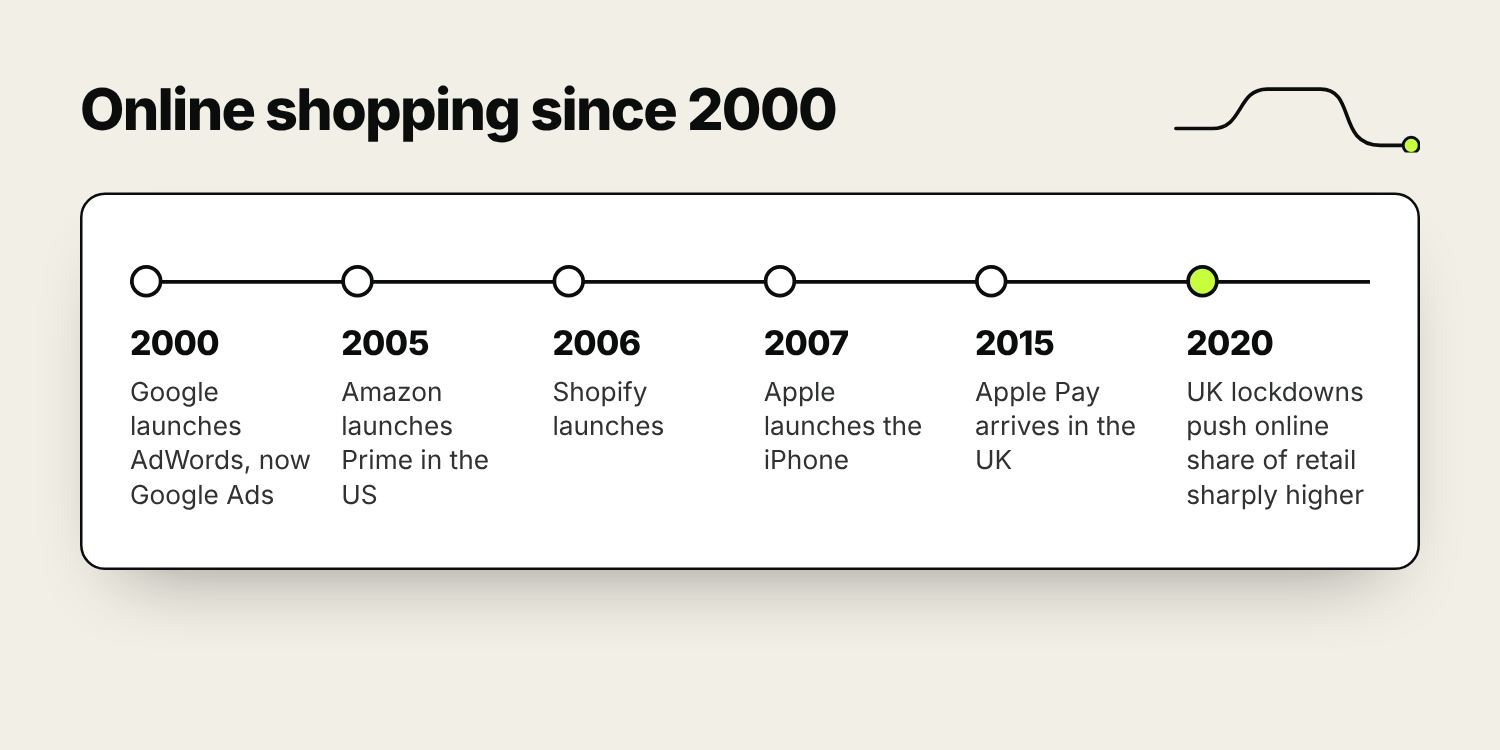
Google launched AdWords (now Google Ads) in 2000, letting any business pay to appear when someone searched for what it sold. Search became one of the main ways people found shops, and it still is.
Paying became easier. eBay bought PayPal in 2002, and PayPal spread to independent shops as a way to pay without typing card details into a site you’d never used before.
Delivery expectations changed when Amazon launched Prime in the US in 2005, bundling fast delivery into a membership. Shoppers started to judge every retailer’s delivery times and charges against it.
Building a shop got cheaper too. Shopify launched in 2006 and WooCommerce, a free shop plugin for WordPress, in 2011. A small business no longer needed a developer to build a catalogue and checkout from scratch.
UK consumer law kept pace. The Consumer Contracts Regulations 2013 give shoppers 14 days to cancel most online purchases, and returns information is now something buyers expect to see on every product page.
Shopping moves to the phone
Apple launched the iPhone in 2007 and the App Store in 2008. Within a few years, browsing and buying on a phone went from awkward to normal, and retailers had to rework sites designed for desktop screens. The term “responsive web design”, for layouts that adapt to the size of the screen, was coined by Ethan Marcotte in 2010.
Google followed the shoppers. In 2015 it started using mobile-friendliness as a ranking signal in mobile search results, and it later moved to mobile-first indexing, where the mobile version of a site is the one it mainly uses to rank it.
Apple Pay arrived in the UK in 2015, with Google’s equivalent following soon after, so paying on a phone became a fingerprint or a glance instead of typing out a card number.
Social media turned into a shop window. Instagram launched in 2010, and over the following decade Instagram, Facebook and later TikTok added ways to tag products in posts and buy them, sometimes without leaving the app.
The 2020 lockdowns and after
When non-essential shops closed in the first UK lockdown in March 2020, buying online became the only option for many purchases. The Office for National Statistics publishes a monthly figure for internet sales as a percentage of all retail sales, and it rose sharply that year. It fell back as shops reopened but stayed above its pre-pandemic level. The latest figure is in the ONS retail sales releases if you want to check where it stands now.
Many small businesses that had never sold online built a shop in weeks during that period, often on Shopify, Squarespace or Wix, or added click and collect and local delivery.
More recently, AI has started to appear in shopping, in product recommendations, in search inside online shops, and in assistants that answer product questions or compare options. It’s too early to say which of these will last.
What the history suggests for an online shop today
- Most of the big jumps came from removing friction: secure card payments, cheaper delivery, paying by phone. Look for the friction in your own checkout before adding anything new. Our guide to website design for conversions covers where to start.
- The dot-com failures spent heavily on attention before they had a business that worked. Know your margins and what you can afford to pay for a new customer before you scale up ad spend.
- The largest retailers set what shoppers expect on delivery, returns and how a site works on a phone. You don’t have to match them, but your delivery and returns terms should be clear before anyone reaches the checkout.
- Search has been one of the main routes to online shops since the early 2000s, and it still is. Being found in Google’s free results and in Shopping ads matters as much for a small shop as a big one. Our ecommerce marketing strategies guide covers the other channels.
Frequently asked questions
When did online shopping start?
It depends on the definition. Michael Aldrich demonstrated teleshopping in England in 1979, a Gateshead resident ordered groceries from Tesco through her television in 1984, and the first widely cited secure card payment on the web was in August 1994.
Who invented online shopping?
Michael Aldrich, an English inventor, is usually credited. In 1979 he demonstrated a system that connected a modified television to a computer over a phone line so people could order from home.
What was the first thing bought online?
The purchase most often cited is a Sting CD, Ten Summoner’s Tales, sold by the US start-up NetMarket in August 1994 and paid for by card over an encrypted connection.
When did Amazon and eBay start?
Jeff Bezos founded Amazon in 1994 and launched it as an online bookshop in 1995. Pierre Omidyar started the auction site that became eBay in 1995.
What was the dot-com crash?
In the late 1990s investors poured money into internet companies, many with no clear route to profit. The Nasdaq peaked in March 2000 and then fell steeply, and many online retailers, including Boo.com, Pets.com and Webvan, closed between 2000 and 2001.
When did online shopping take off in the UK?
It grew steadily through the 2000s and moved onto phones after the iPhone arrived in 2007. The biggest single jump came in 2020, when lockdowns closed non-essential shops and ONS figures show the online share of retail sales rising sharply.

Founder of The Pursuit Agency in Swindon. He has worked in SEO for fifteen-odd years and leads the agency's SEO and Google Ads work for owner-led businesses across the UK.