
The short version
- Homeowners choose on trust first: Google reviews, photos of your own similar jobs and the scheme memberships you hold.
- Work out what a job is worth and how many enquiries it takes to win one. That sets the most you can pay per enquiry.
- Fix the free basics before paying for leads: Google Business Profile, a page per service, a gallery of real work and a review request after every job.
- Reply the same day, get quotes out quickly and follow up every one. Raising your win rate is usually cheaper than buying more enquiries.
- Plan for the waves: keep reviews and photos going when you’re flat out, and turn paid search up when the diary has gaps.
A marketing plan for a construction company or trade business fits on one page. It says who your customers are and how they pick someone, why they should pick you, what a job is worth and what you can spend to win one, which channels you’ll use and in what order, and how you’ll know it’s working. Review it every three months.
This guide is for owners of small UK building firms and trades (builders, electricians, plumbers, heating engineers, roofers, landscapers) who spend the day on site and get enquiries in bursts. For channels beyond the ones covered here, see our wider guide to small business marketing strategy. There are worked plans for other businesses too: a law firm, a dental practice and a small clothing business.
What goes in a marketing plan for a construction company

Who your customers are and how they choose
Homeowners and landlords usually start with a recommendation, then check you out: your Google reviews, photos of jobs like theirs, the scheme they’ve heard of. Many get two or three quotes. Besides the price, they want to know you’ll turn up when you say, keep the site tidy, answer the phone mid-job and not let the cost creep.
Commercial customers (main contractors, developers, housing associations, managing agents) choose on accreditations, safety paperwork, insurance, capacity and a record of turning up. Price matters, but a missed start date costs them more than a slightly higher rate.
Write down the mix you want, as specifically as you can: for example, “two more single-storey extensions a quarter and fewer small repair jobs”.
Why they should choose you
Fill in this sentence: “We do [type of work] for [customer] in [area], and unlike most firms round here we [something specific you can prove].” Words like “quality workmanship” and “reliable” are on every builder’s van. Better examples: a written start date, one named person who answers the phone for the whole job, a specialism such as period properties or flat roofs, or progress photos sent to the customer every week. Pick one or two you already do well and put them on your website, quotes and van.
What a job is worth and what you can pay to win one
Before you pay for any lead, work out the gross profit on a typical job and how many enquiries it takes to win one, using your last year of quotes.
Example only. Use your own numbers.
| Step | Example |
|---|---|
| Average job value, excluding VAT | £6,000 |
| Gross profit after materials, labour and subcontractors (30%) | £1,800 |
| Enquiries that turn into a site visit and quote | 1 in 2 |
| Quotes accepted | 1 in 3 |
| Enquiries needed to win one job | 6 |
| Share of gross profit you’ll spend to win a job (15%) | £270 |
| Most you can pay for one enquiry | £45 |
Compare that last figure with what each channel costs you per enquiry, which means logging where every enquiry comes from.
The same sum shows why quoting matters. In the example, winning 1 in 2 quotes instead of 1 in 3 cuts the enquiries needed per job from six to four, without spending a penny more on marketing. Repeat work and referrals add value on top; count them when judging a channel, but don’t build the budget on them.
Marketing for tradesmen: the channels, in order
Each step makes the next one cheaper. Ads that send people to a firm with eight reviews and no photos waste much of the money.
1. Google Business Profile and reviews
Searches like “roofer near me” usually show a map of local firms near the top of Google, drawn from Google Business Profiles. Choose the most specific primary category for the work you want (Roofing contractor, Electrician, Plumber, Landscaper and so on), list each service, and set the areas you cover. If customers don’t visit your yard or office, you can hide the address and show a service area instead. Add photos from real jobs every week or two.
Reviews do most of the persuading. Ask every customer at handover, text them a direct review link the same day, and reply to every review, including the poor ones, calmly and with the facts. Our local SEO service covers the profile and your website together.
2. A website that proves you do the work
People go to your website after a recommendation to check you’re real. It needs a page for each main service (extensions, rewires, boiler installs, flat roofs, patios), the areas you cover, a tap-to-call phone number and a short quote form asking for postcode, job type, timescale and photos.
The most useful section is a project gallery: before, during and after photos with a few lines on the job, the village or part of town (never the address), how long it took and any problem you solved. Stock images of smiling builders in clean hard hats tell a homeowner nothing about you. If yours needs rebuilding, our website design page explains how we approach it.
3. Past customers, referrals and the neighbours
You can make word of mouth work harder:
- Keep a list of past customers and, where they’ve agreed to hear from you, get in touch once a year. Landlords and recent movers often have more work coming.
- With the customer’s agreement, put a card through neighbours’ doors when you start, saying what you’re doing, for how long and how to reach you. A site board and a signwritten van work on passers-by.
- Build referral links with people who see jobs before you do: architects, structural engineers, estate and letting agents, kitchen and bathroom showrooms, and trades that work alongside yours.
4. Paid search for the jobs you want more of
Google Ads puts you in front of searches such as “loft conversion” or “emergency plumber” in your area, at hours you’ll answer the phone. Unlike reviews and SEO, it can be turned up when the diary has gaps and down when you’re booked solid. Start with your most profitable job type, use call tracking, and judge it on jobs won. Our Google Ads page explains how we set this up.
5. Lead platforms and trade directories
Checkatrade, Rated People, MyBuilder and Which? Trusted Traders work differently and change how they charge, so read the current terms and notice period before signing up.
| Type | Examples | Good for | Watch out for |
|---|---|---|---|
| Vetted directories and endorsement schemes | Checkatrade, Which? Trusted Traders | A recognised badge and reviews that homeowners trust, especially if you have few Google reviews yet | An ongoing cost whether or not work comes in, and reviews that sit on their site |
| Job-posting platforms | Rated People, MyBuilder | Filling gaps, and new firms building a track record | Several trades can be chasing the same job, so you compete on speed and price, and you may pay before you know if the job is real |
Log each platform’s cost, enquiries and jobs won like any other channel, and drop the one that brings tyre-kickers.
6. Social media and local groups
Town and village Facebook groups are full of people asking for a builder or a plumber, and a past customer recommending you there carries more weight than your own posts. For visual work (landscaping, extensions, kitchens, roofing), post progress photos, short walk-round videos and before-and-after shots. One decent post a week from photos taken on site is enough.
Trade bodies, scheme badges and the rules on claims
Scheme logos persuade homeowners, so only show the ones you hold.
- Gas work on boilers, cookers, fires and other gas appliances must, by law, be done by someone on the Gas Safe Register. Engineers carry a Gas Safe ID card showing the types of work they’re qualified for, and customers can check the register online.
- NICEIC and NAPIT run registration schemes for electricians, and TrustMark is a government-endorsed quality scheme for work in and around the home. The Federation of Master Builders (FMB) is a trade association that vets and inspects builders before they join.
- Show a badge only while your membership is current, only for the business that holds it, and only for the type of work it covers. Each scheme has its own logo rules, customers can look you up on the scheme’s site, and showing a membership you don’t hold is misleading advertising under UK consumer law.
- Claims such as “fully insured”, “guaranteed” or “the area’s best-rated roofer” need evidence you could produce. The UK advertising codes cover your website and social posts as well as paid ads, and prices shown to homeowners should include VAT.
- Writing or buying fake reviews, or hiding genuine bad ones, is banned under UK consumer law. Google’s own policies also forbid offering discounts or gifts in return for reviews.
- Ask the customer before you photograph their home for marketing, and leave out house numbers, faces and car registrations.
Quoting speed and follow-up
If a homeowner waits two weeks for your quote, they may have booked someone else by the time it arrives.
- Set a voicemail that says when you’ll call back, and keep to it. Many phone systems can text missed callers automatically.
- Ask for photos on your quote form so you can rule out unsuitable jobs before driving out.
- Set a target for getting quotes out, in working days, and measure it.
- Make the quote easy to accept: scope, exclusions, payment stages, likely start date, insurance and scheme details, and links to a similar job and your reviews.
- If the customer agrees the job in their own home, they usually have 14 days to cancel and you must tell them so in writing. Put it in your templates.
- Follow up every quote a few days after sending it, and again a week or two later. If you lose, ask why.
Plan for the busy and quiet months
Mark your busy and quiet months from the last two years of enquiries or bank statements, and check Google Trends for your services. Heating engineers tend to get more breakdown calls when the weather turns cold, roofers after storms, and landscapers and builders doing outdoor work often find customers start planning in late winter for spring and summer.
Building work is booked weeks or months ahead, so start pushing for a quiet patch well before it arrives. When you’re flat out, keep the free habits going (reviews, photos, project write-ups), give honest start dates, keep a waiting list, and narrow your ads to the most profitable jobs instead of switching everything off.
Winning work from main contractors and frameworks
Commercial buyers, quantity surveyors and site managers decide differently, and the first hurdle is usually paperwork.
- Pre-qualification. Many contractors use a standard questionnaire such as PAS 91 and ask for accreditations such as CHAS, Constructionline or SafeContractor. Ask which ones they require before paying for several.
- A capability statement: one page (PDF and web page) covering what you do, team size, areas, accreditations, insurance, recent projects and references.
- Relationships. Get on approved supplier lists, meet site managers, do a small package of work well, and use LinkedIn to keep in touch.
- Frameworks are lists of approved contractors that public bodies and housing associations award work to, usually through a formal tender covering several years. Small firms often start as a subcontractor to a firm already on one.
Example: an invented building firm’s one-page plan
Example: an invented building firm with eight people, doing extensions and loft conversions across a market town and its surrounding villages, plus some groundworks for a regional main contractor. All figures are examples.
| Section | What the plan says |
|---|---|
| Customers | Homeowners adding space instead of moving, found through recommendations and Google. One main contractor for groundworks. |
| Why us | Fixed start dates in writing, one named project lead per job, and weekly photo updates to the customer. |
| Numbers | Average extension £45,000 at 20% gross profit (£9,000). Eight enquiries per job won. Spend up to 5% of gross profit (£450) per job, so about £55 per enquiry. Ten extensions this year needs about 80 enquiries. |
| Channels, in order | Google profile and review requests. Project gallery and service pages. Neighbour cards and site boards. Two local architects as referral partners. Google Ads for extension searches within 15 miles, turned up in autumn and late winter. |
| Commercial | Keep the health and safety accreditation the main contractor asks for, send a capability statement to two more contractors, and ask the current one for a reference. |
| Measure | Enquiries by source, win rate, days to quote, cost per enquiry from ads and weeks booked ahead, reviewed monthly. |
What to do in the first 90 days
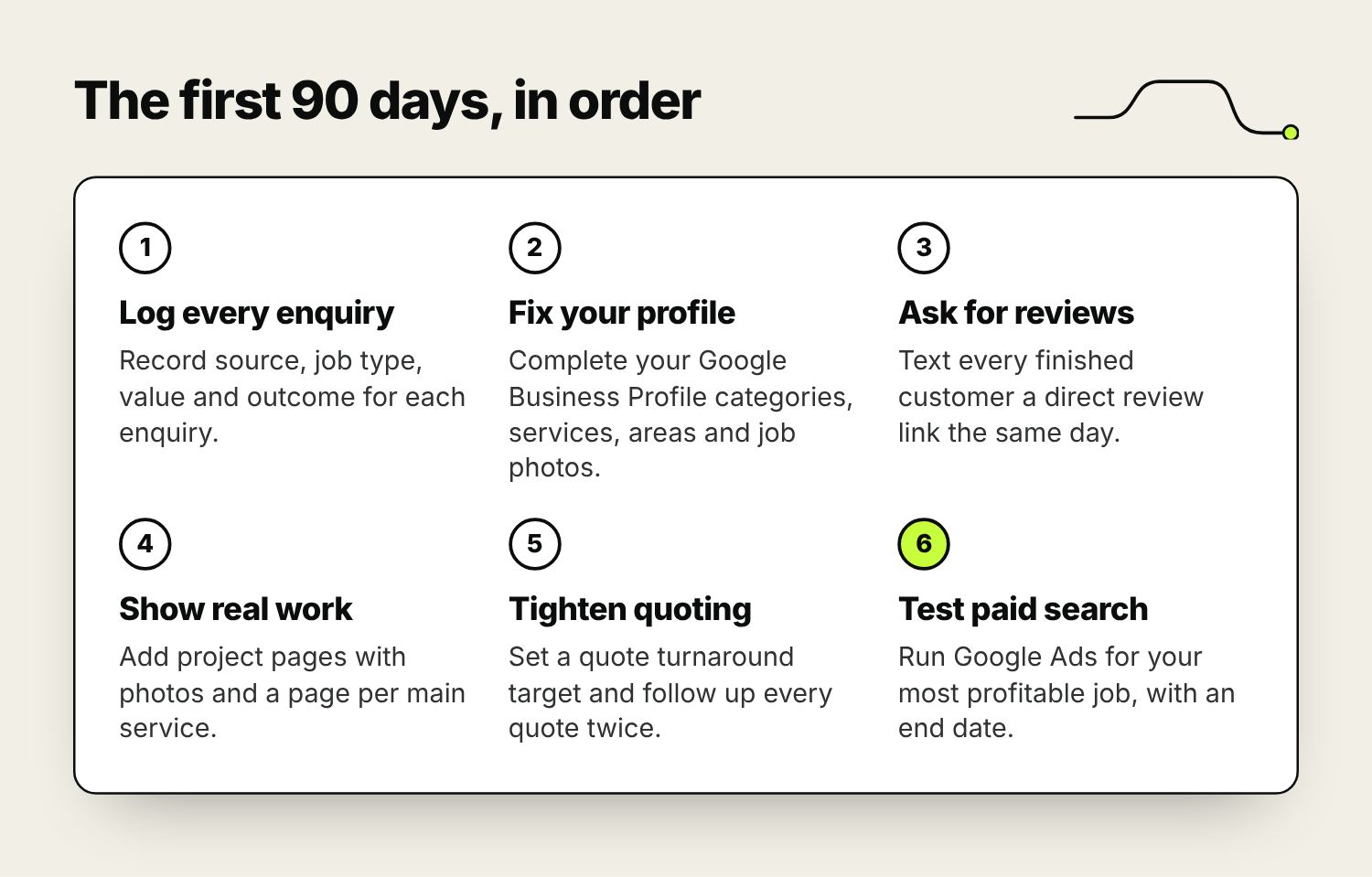
| Month | Focus | Actions |
|---|---|---|
| 1 | Foundations | Start an enquiry log and ask every caller how they heard of you. Write your “why us” sentence and work out your numbers. Complete your Google Business Profile. Ask customers from the last six months for a review. |
| 2 | Proof | Write up three recent jobs as project pages and add a page per main service. Check your badges are current. Tidy your quote template and set a turnaround target. |
| 3 | Growth | Contact referral partners and past customers. Test Google Ads for your most profitable job, or one lead platform, with a fixed budget and end date. Review the log and plan the next 90 days. |
How to tell if it’s working
Your enquiry log is the measure. Record each enquiry’s date, source, job type, rough value, whether you quoted and whether you won. Once a month, check enquiries and jobs by source, cost per job won from each paid channel against your limit, quote win rate, days to quote, Google reviews and how many weeks ahead you’re booked.
Call tracking on ads and GA4 tracking on your quote form stop the log relying on memory. If you bring in an agency, ask them to report on enquiries and jobs won, and ask who will work on your account and how long the contract runs. If you want help putting the plan together, our marketing strategy work starts with who you sell to, what’s working now and what to do first.
Frequently asked questions
How do I get more customers for my building or trades business?
Start with what’s free: a complete Google Business Profile, a review request after every job, real project photos on your website and cards through neighbours’ doors. Reply quickly and follow up every quote. Then add Google Ads for the jobs you most want, judged on jobs won.
Is Checkatrade, Rated People or MyBuilder worth it?
It depends on your trade, your area and how many Google reviews you already have. Vetted directories can help a newer firm look trustworthy. Job-posting platforms can fill gaps, but several trades may chase the same job. Try one at a time, read the current terms, and track the cost per job won.
How much should a construction company spend on marketing?
Work it out from your own numbers. Decide what share of a job’s gross profit you’ll spend to win it, divide by the enquiries it takes to win a job, and multiply by the enquiries you need to hit your target.
Do tradesmen need a website if they get work from word of mouth?
Yes. Most people check a firm online after a recommendation, and a simple site with your services, areas, real project photos and reviews reassures them. It also gives Google something to show when people search for your trade in your town.
How do small building firms get work from main contractors?
Hold the accreditations and insurance they ask for, have a capability statement ready, get onto their approved supplier lists and do a small package of work well. Many small firms reach framework work as a subcontractor.
What should a builder post on social media?
Progress photos and short videos from real jobs, before-and-after shots, and now and then how you solved a problem on site. Ask customers before posting their home and leave out house numbers.

Founder of The Pursuit Agency in Swindon. He has worked in SEO for fifteen-odd years and leads the agency's SEO and Google Ads work for owner-led businesses across the UK.