

The short version
- Pick a narrow customer and a reason to buy from you that a high-street chain can’t easily copy. The rest of the plan follows from that.
- Work out your profit per order, after returns and postage, before you spend anything on ads. That tells you the most you can pay to win a customer.
- Start with two or three channels you can keep up every week, usually one social platform for being seen and email for repeat sales.
- Product pages sell clothes: measurements, fit notes, photos on different bodies and clear returns information.
- Plan in 90-day blocks around your drops and the retail calendar, and review sales by channel every month.
A marketing plan for a small clothing business fits on one page. It says who you’re selling to, why they’d choose you over the brands they already buy from, what you can afford to spend to win a customer, which channels you’ll use, and how you’ll tell whether it’s working. You then revisit it every quarter. Our list of marketing ideas for small businesses has more channels to choose from. There are worked plans for other businesses too: a law firm, a construction or trades business and a dental practice.
This guide is for small UK clothing brands that sell mostly online, from a founder making pieces at the kitchen table to an independent label with a shop and a website.
Know exactly who you’re dressing
The most common mistake in a clothing marketing strategy is aiming at everyone aged 18 to 45 who likes nice clothes. Big brands can afford to be broad. A small brand does better as the obvious choice for a narrower group.
Describe your customer in terms you can act on: where they shop now, which accounts they follow, what they’d spend on a piece like yours, what they need their clothes to do (survive a commute, fit a taller frame, last more than one season) and what annoys them about the options they have.
Get this from real people. Message your first 20 customers or followers and ask why they bought and what nearly stopped them. Read reviews of the brands they mention, especially the three-star ones, which tend to say exactly what’s missing.
Write your positioning in one sentence
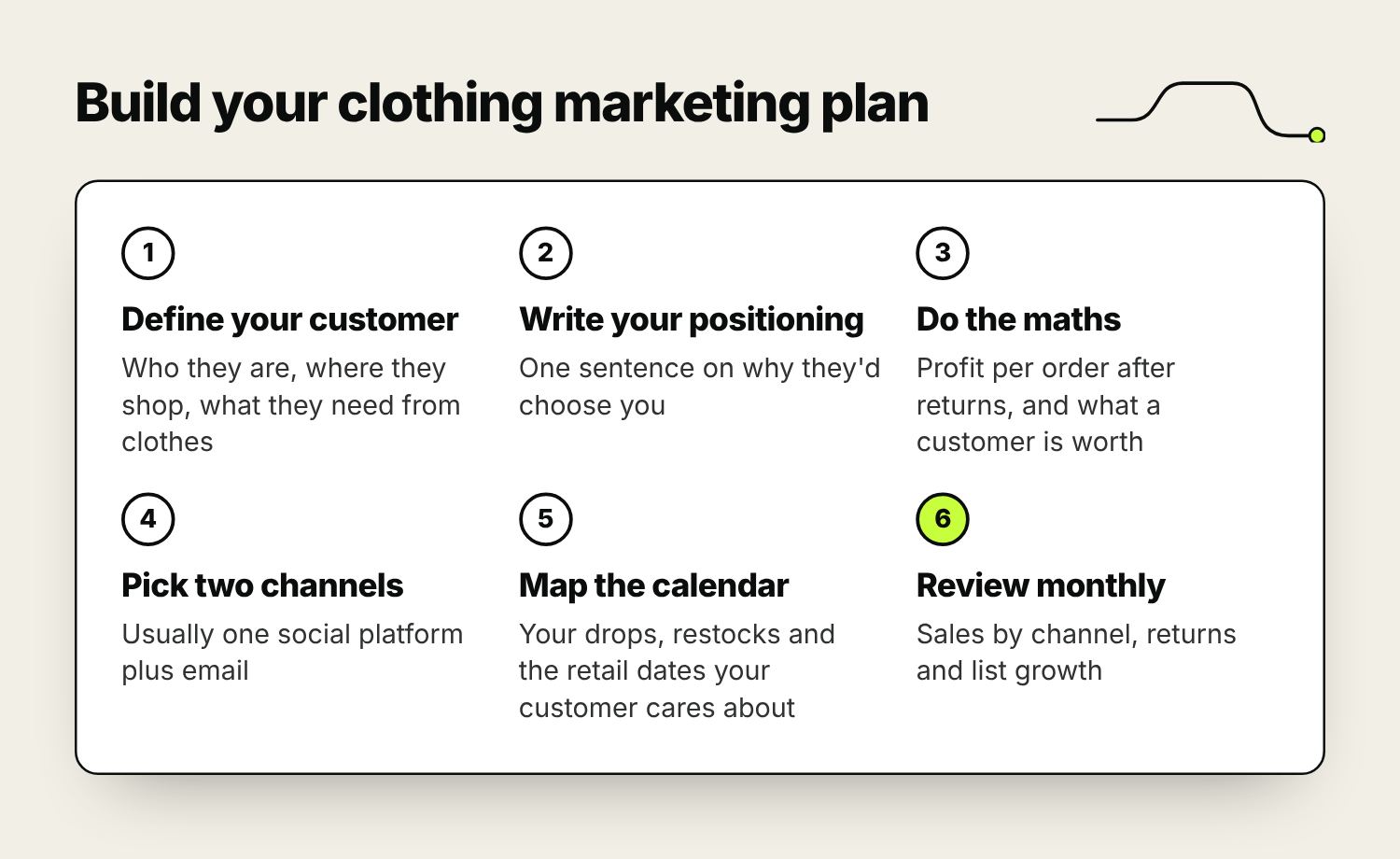
Fill in: “We make [product] for [customer] who [need], unlike [the usual alternative].” For example: “We make merino base layers for women who hike in the UK, cut for longer bodies, unlike the unisex kit that fits nobody properly.” If you can’t fill it in yet, sort that out before spending on marketing, because every post, product page and ad will be vaguer without it.
Look at the competition properly
Pick five brands your customer also buys from. For each one, note the price points, the photography style, which channels they’re active on, how they handle sizing and returns, and what customers complain about in reviews and comments. You’re looking for the gap: a fit, a price, a fabric, a tone of voice or a level of service that nobody is doing well.
Work out your numbers first
Clothing has costs that catch new brands out: returns, sizes left over at the end of a run, postage and packaging, and discounting. Before you plan any paid marketing, work out what an order is worth to you.
Example only. Use your own costs.
| Per order | Example |
|---|---|
| Average order value | £60.00 |
| Cost of the clothes, including labels and trims | £18.00 |
| Packaging and postage | £5.00 |
| Card and payment fees | £1.50 |
| Allowance for returns, spread across all orders | £4.00 |
| Profit per order before marketing | £31.50 |
In that example, spending more than £31.50 on advertising to win a first order loses money on that order. That can still make sense if customers come back, so check what share of your customers order again within a year (your shop platform’s customer reports will show this), then set the most you’re willing to pay for a new customer.
Give returns their own line in the plan. Track the return rate and the reasons for each product. If one style keeps coming back as “too small”, the fix is the size guide or the pattern, and more marketing won’t help.
Choose two or three channels and do them properly
A small team can’t do everything well. Pick the channels where your customer already spends time and that you can keep up every week.
| Channel | Good for | What it takes |
|---|---|---|
| Showing the product, building a following, direct messages that turn into sales | Regular posts, Reels and stories, and replying to comments and DMs | |
| TikTok | Reaching new people quickly with short video | Frequent, informal video showing fit, styling and how things are made |
| Creators and influencers | Getting in front of an audience that trusts the person recommending you | Finding small creators whose followers match your customer, a clear brief, and ads labelled properly under UK advertising rules |
| Turning followers and one-off buyers into repeat customers | A sign-up reason, automated emails and regular sends | |
| Meta ads (Facebook and Instagram) | Testing products and creative, and reminding site visitors to come back | A test budget you can afford to lose and a steady supply of new images and video |
| Google Shopping ads | Reaching people searching for a specific item, such as “linen trousers tall women” | A clean product feed in Google Merchant Center and enough margin per order |
| SEO | Being found for product and category searches over the long term | Well-written collection and product pages, and patience |
| Marketplaces such as Etsy or Depop | Early sales and testing demand | Fees, and less control over the customer relationship |
| Pop-ups, markets and wholesale | Meeting customers, hearing feedback on fit, local press | Time, stock and stall or wholesale margins |
A typical starting mix for a new brand is one social platform for being seen, email for repeat sales, and either creators or paid social to reach new people. Add Google Shopping and ecommerce SEO once you have a range and product pages worth sending people to.
Content that sells clothes
People buying clothes online want to know how a piece will look on someone like them, how it fits and what it feels like. Content that answers those questions does more selling than polished brand imagery on its own.
- The same piece on different body shapes and heights, with each model’s height and the size they’re wearing.
- Short videos of the garment moving, and close-ups of the fabric and stitching.
- Styling posts showing several ways to wear one piece.
- Behind the scenes: sampling, choosing fabric, packing orders. For a small brand, the people behind it are part of why customers buy.
- Customer photos and reviews, shared with permission.
- Answers to the questions you keep getting in DMs, turned into posts.
Batch the work. With a planned shot list, one shoot per collection or per month can give you product photos, several weeks of social posts and images for your emails.
Make your website do the selling
Social media gets attention, but aim to finish most sales on your own site, where you keep the customer’s details and pay no marketplace commission.
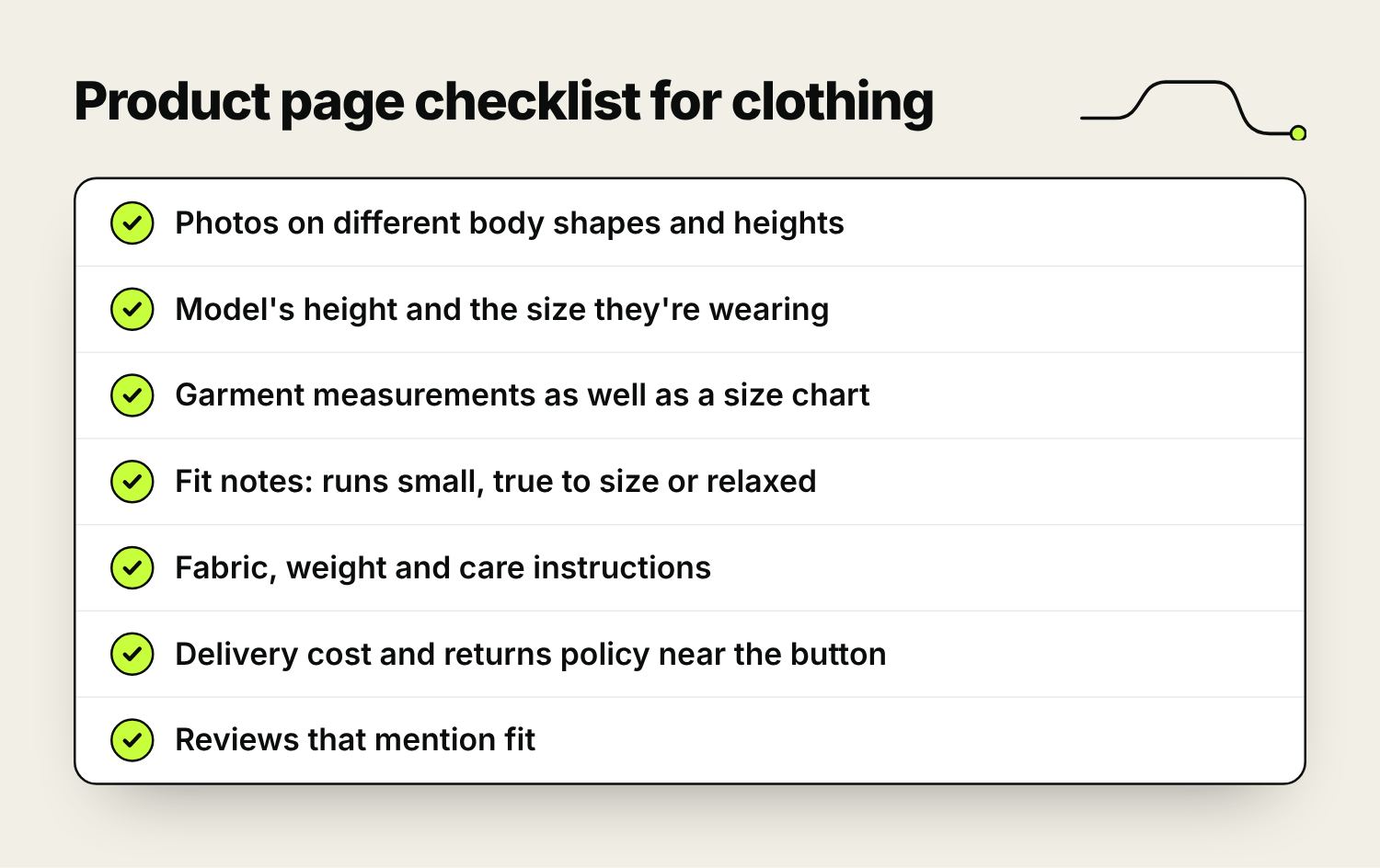
Organise collections the way customers search: by product type (“linen shirts”), by occasion (“wedding guest dresses”) and by fit (“petite jeans”) if fit is part of your offer. A collection page with a short, useful introduction gives Google something to rank. If you’re still choosing a platform, our comparison of the best ecommerce platforms for SEO covers the options, and our guide to website design for conversions covers product pages and checkout in more detail.
Build an email list from day one
Social platforms decide who sees your posts. Your email list is an audience you own, and for many small clothing brands it’s where most repeat sales come from. Give people a reason to sign up, such as early access to drops, and set up these automated emails first:
- Welcome: the story behind the brand, your best sellers and any sign-up offer.
- Abandoned basket: a reminder an hour or so after someone leaves, then one more the next day.
- After purchase: care instructions and styling ideas, then a review request once they’ve had time to wear it.
- Back in stock: let people sign up for sold-out sizes. It also tells you what to reorder.
- Win-back: a note to customers who haven’t ordered for a while.
Under UK rules (PECR and UK GDPR) you need consent before sending marketing emails, with an exception known as the “soft opt-in” for people who have bought from you and were given a clear chance to opt out. Use a proper email platform that records consent and handles unsubscribes for you.
Plan around drops and the retail calendar
Clothing runs on seasons and launches. Map out the year: your own drops and restocks first, then the dates that matter to your customer, such as Valentine’s Day, wedding season, summer holidays, back to school, Black Friday, Christmas and the January sales.
Decide your discount policy in advance. Constant sales teach customers to wait for the next one. Launches, limited runs and a gift with purchase are ways to give people a reason to buy now that protect your margin better than a blanket percentage off.
For each drop, plan the build-up. Tease it on social and email two or three weeks ahead, open an early-access list, launch to email subscribers first, then social, then ads.
A 90-day marketing plan you can copy
| Month | Focus | Actions |
|---|---|---|
| 1 | Foundations | Write your customer description and positioning sentence. Work out profit per order. Fix product pages and size guides. Set up GA4, sales tracking and your email platform, with welcome and abandoned basket emails. Plan and book a content shoot. |
| 2 | Consistency | Post on your chosen platform to a set schedule. Send product to five to ten small creators whose followers match your customer. Start a small paid social test on your best seller. Email your list every week or fortnight. |
| 3 | Launch and review | Run a drop or restock using the build-up above. Put more into what’s bringing sales and stop what isn’t. Review sales by channel, return reasons and list growth, then write the next 90 days. |
How to tell if it’s working
Check these once a month in a simple spreadsheet:
- Sales and orders by channel. Use your shop platform’s reports alongside GA4, and add UTM tags to the links in your bio, emails and ads so you can see where sales came from.
- Conversion rate for the site and for your top product pages.
- Average order value.
- Cost per new customer from paid channels, compared with the most you said you’d pay.
- Repeat customer rate.
- Email list size and sales from email.
- Return rate and reasons.
Followers and likes are worth watching, but they don’t pay for stock. If a channel brings attention but no sales after three months of honest effort, change the approach or move the time elsewhere.
Setting a marketing budget
No percentage of turnover suits every brand. Work from your own numbers instead: what you can afford to pay for a new customer, how many new customers you want this quarter, and what that adds up to.
Example: if you want 100 new customers this quarter and can afford £20 to win each one, your paid budget is up to £2,000 for the quarter, plus the cost of photography and content.
Run paid tests with a fixed budget and an end date, and judge them on sales. When you’re spending enough that managing it properly takes more time than you have, that’s usually the point to bring in help.
Frequently asked questions
What is the best marketing strategy for a clothing business?
Focus on a clearly defined customer and a reason to choose you, then use one social platform to be seen, email to turn followers into repeat buyers, and product pages that answer every fit question. Add paid social, Google Shopping and SEO once you know your margins and have a range worth promoting.
How do I market a small clothing brand with little or no money?
Post consistently on the one platform your customer uses most, show the product on real people, gift pieces to small creators whose followers match your customer, and collect email addresses from the start. Markets and pop-ups also bring sales and direct feedback on fit.
How much should a small clothing business spend on marketing?
Work it out from your numbers. Calculate profit per order after returns and postage, decide what you can pay to win a new customer, and multiply by the number of new customers you want. Test paid channels with a fixed budget and an end date.
Is Instagram or TikTok better for a clothing brand?
It depends where your customers spend time and what you can keep up. TikTok can reach new people quickly with frequent, informal video. Instagram is strong for showing the product and building a following that buys. If you’re short on time, do one well rather than both half-heartedly.
Do small clothing brands need influencers?
Not always, but small creators whose followers match your customer can be an affordable way to reach new people. Brief them clearly, track sales with codes or tagged links, and make sure paid or gifted posts are labelled as ads under UK advertising rules.
How long does it take for marketing to work for a new clothing brand?
Expect to spend about three months building content, an email list and a posting rhythm before you can judge a channel fairly. Paid ads show results faster, while SEO usually takes longer.

Founder of The Pursuit Agency in Swindon. He has worked in SEO for fifteen-odd years and leads the agency's SEO and Google Ads work for owner-led businesses across the UK.