
The short version
- A podcast is worth it for a small business when it does a specific job: showing what you know to the people who buy from you, opening doors to people you’d like to work with, or feeding the rest of your marketing.
- It usually isn’t worth it if you’re hoping for a large audience quickly, if your customers don’t listen to podcasts, or if you can’t keep publishing for at least six months.
- Most business podcasts never reach a big audience, and they don’t need to. A small audience of the right people can be worth more than thousands of downloads.
- Judge it on what it leads to, such as enquiries, introductions and new clients, not on downloads.
- The cheapest way to find out is to record one or two episodes before committing.
A podcast can be one of the best things a small business does for its marketing, or a time-consuming hobby that quietly stops after six episodes. The difference is rarely the microphone or the editing. It’s whether the show was set up to do a job for the business from the start. This guide is honest about when a podcast is worth it, when it isn’t, and how to test it cheaply before you commit.
For the money side, read how much it costs to start a podcast. For the practical steps, see how to start a podcast for your business.
What a podcast can do for a small business
A business podcast rarely makes money directly. What it can do is help the rest of the business in four ways.
Show what you know
Thirty minutes of you explaining how you’d solve a problem tells a prospective client more than any brochure. By the time they get in touch, they already know how you think and whether they like you. That shortens the sales conversation.
Open doors
Inviting someone onto your show is one of the easiest ways to start a conversation with a person you’d like to work with: a potential client, a referral partner or an expert in your field. People say yes to being interviewed far more often than they say yes to a sales meeting.
Feed the rest of your marketing
One recorded conversation becomes an episode, a YouTube video, a blog post and a month of short clips for social media. For a business that struggles to keep posting, that’s often the most valuable part. Read one recording, a month of content.
Build trust over time
Listeners spend a long time with your voice. Someone who has listened to ten episodes feels they know you, and that familiarity is hard to build any other way.
When a podcast is worth it
A podcast tends to work for businesses where:
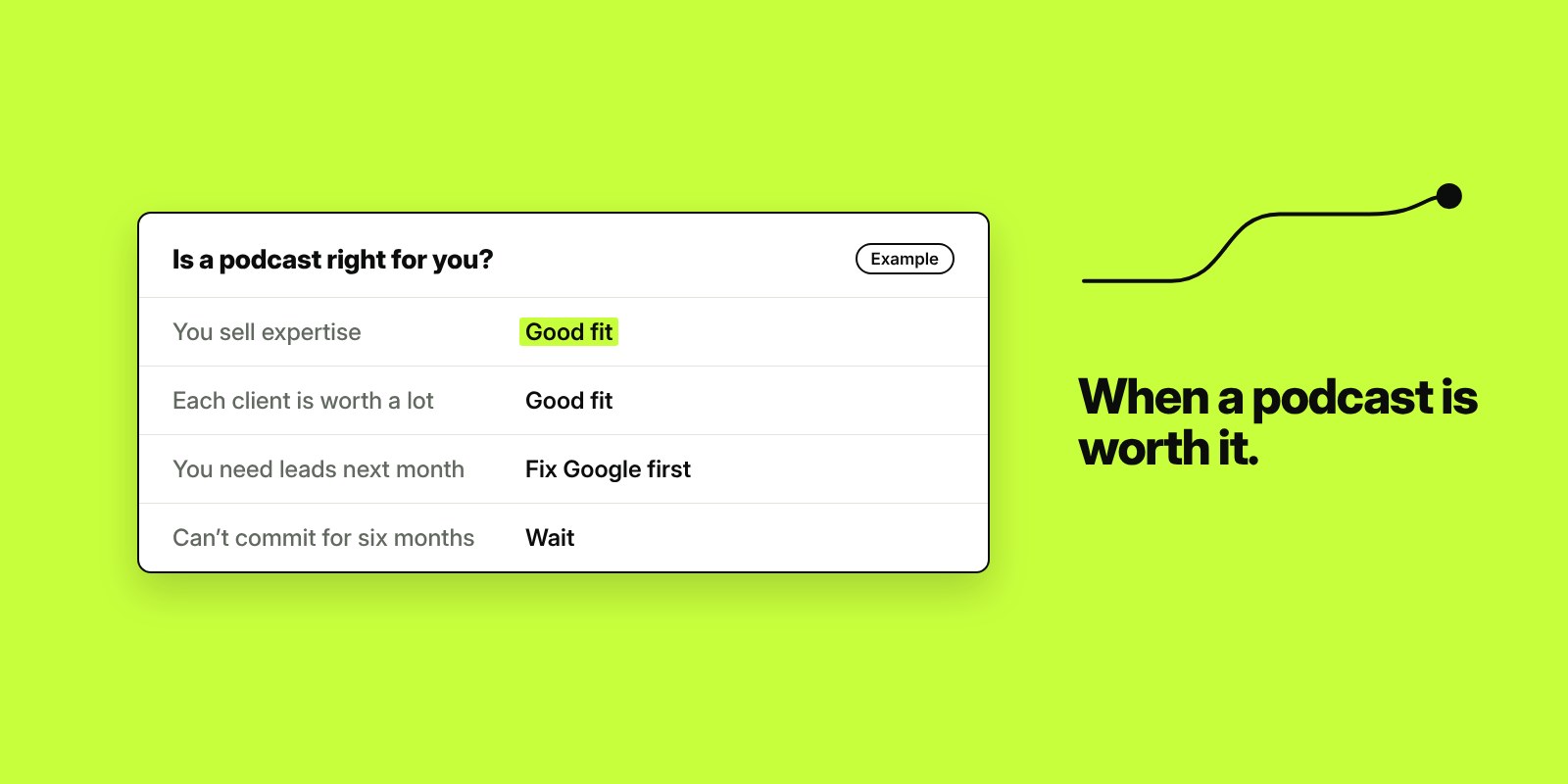
- Expertise is what you sell. Consultants, coaches, accountants, solicitors, agencies, financial advisers and specialist trades all fit.
- Each client is worth a lot. If one new client pays for a year of episodes, the maths is easy.
- Buying takes time. When people research for weeks before they get in touch, a back catalogue of episodes does a lot of the persuading.
- Relationships matter. If referrals and partnerships drive your business, guest interviews are a natural way to build them.
- You enjoy talking about your work. It comes through, and it’s what keeps you going after the novelty wears off.
When a podcast probably isn’t worth it
Being honest about this matters, because a half-finished podcast can do more harm than none at all.
- You want a big audience quickly. Most podcasts grow slowly. If you need enquiries next month, fix your Google Business Profile, your website or your Google Ads first.
- Your customers buy on price or urgency. Someone with a burst pipe isn’t going to listen to a plumber’s podcast. They’ll call whoever turns up first on Google.
- You can’t commit. A show with three episodes and a gap of a year looks abandoned. Plan for at least six months.
- Nobody will use the clips. If you won’t post the short videos, you lose much of the value.
- The basics aren’t in place. If your website doesn’t turn visitors into enquiries, a podcast will send people to a page that lets them down. Sort the website first.
How to tell whether it’s working
Downloads are the number everyone looks at, and they’re the least useful one for a business. A show with 200 listeners who are all potential clients is worth more than one with 20,000 who will never buy. Measure what the show leads to:
| Measure | How to track it |
|---|---|
| Enquiries that mention the podcast | Add “How did you hear about us?” to your enquiry form, and ask on every first call |
| Introductions from guests | Keep a simple list of who you interviewed and what came of it |
| Visits from episode pages to your service pages | Google Analytics, by looking at where visitors go after an episode page |
| Clips watched on social media | The platform’s own figures, alongside comments and messages they prompt |
| Sales calls that start warmer | Note when a prospect says “I’ve been listening to your podcast” |
Give it at least six months and around a dozen episodes before deciding. Most podcasts take that long to find their feet.
Test it before you commit
You don’t have to buy equipment or commit to a year to find out whether podcasting suits you.
- Record one or two episodes in a studio, so the sound and video are good from the start. Read what happens at a recording session.
- Use them. Publish the episodes, post the clips and send the episodes to a few clients and prospects.
- Ask for honest feedback. Did people listen? Did it start any conversations?
- Then decide whether to commit to a regular show.
If you’re a business owner in or around Swindon, we’re recording a free, fully edited podcast episode for ten local businesses, which is the cheapest test there is. When you’re ready to launch properly, our Podcast Setup gets the show, channels and plan in place.
Fitting a podcast into your marketing
A podcast works best as one part of a plan, not on its own. It sits well alongside SEO, because episode pages give your website more useful content, and alongside social media, because the clips give you something worth posting. If you’d like help deciding where a podcast fits and what should come first, that’s what our marketing strategy work covers.
Frequently asked questions
Is a podcast worth it for a small business?
It can be, if it does a specific job such as showing your expertise to the people who buy from you, opening doors to potential clients, or giving you content for social media. It’s rarely worth it if you need a large audience quickly or can’t commit to publishing for at least six months.
How many listeners does a business podcast need?
Fewer than you’d think. A business podcast doesn’t need a big audience; it needs the right one. A few hundred listeners who could become clients can be worth far more than thousands who never will.
How long does it take for a podcast to bring in work?
Plan for at least six months and around a dozen episodes. Guest interviews can open doors straight away, but a back catalogue that persuades prospects takes time to build.
Do podcasts help with SEO?
Indirectly, yes. Each episode can have its own page on your website with show notes, which gives Google more useful content to rank, and guests often link to the episode from their own sites.
What kinds of businesses suit a podcast?
Businesses that sell expertise and where each client is valuable: consultants, coaches, professional services, agencies, specialist trades and B2B companies. Businesses that win work on price or urgency usually get more from Google search and ads.
How can I try a podcast without a big commitment?
Record one or two episodes in a studio, publish them and see what they lead to. That avoids buying equipment before you know you’ll keep going.

Founder of The Pursuit Agency in Swindon. He has worked in SEO for fifteen-odd years and leads the agency's SEO and Google Ads work for owner-led businesses across the UK.