
The short version
- A dental marketing plan fits on one page: which patients you want, how they choose a dentist, why they’d pick you, what a case is worth, which channels you’ll use in what order, and how you’ll measure it.
- Work out what an implant case, an aligner case and a new private patient are worth to the practice before you set any ad budget. That number tells you what you can pay for a consultation.
- For most independent practices the order is: Google Business Profile and reviews, treatment pages with prices and finance, Google Ads on treatment searches, then campaigns to the patients you already have.
- Everything you publish has to meet GDC guidance and the advertising code: honest claims, registration details on your website, no “specialist” unless the dentist is on a GDC specialist list, written consent for patient photos, and no advertising of prescription-only medicines such as botulinum toxin to the public.
- Judge the plan on consultations booked and treatment started by source, not on clicks or followers.
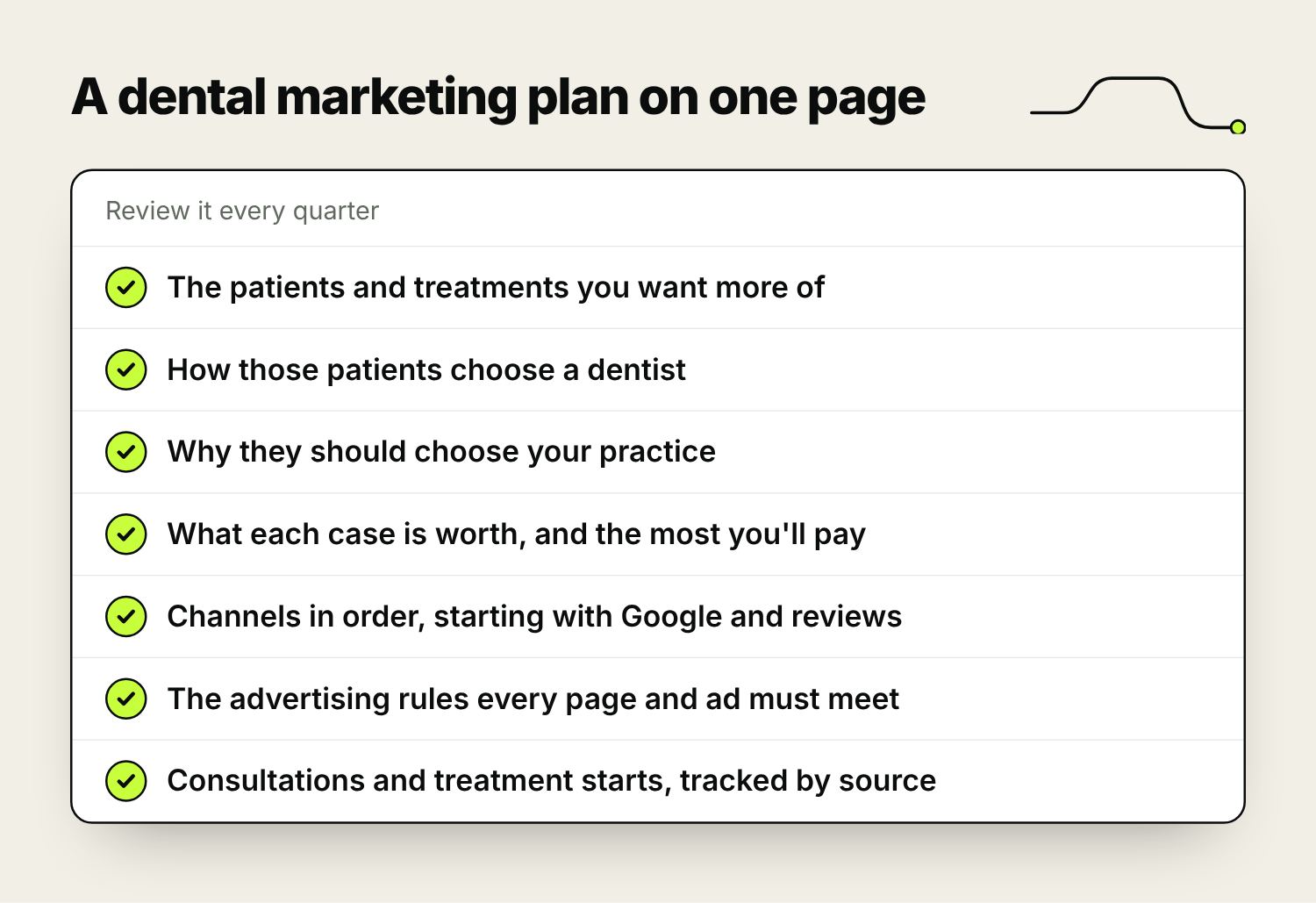
A marketing plan for a dental practice should fit on one page. It says which patients and treatments you want more of, how those patients choose a dentist, why they should choose you, what each new case is worth and what you can afford to pay to win it, which channels you’ll use and in what order, and how you’ll know it’s working. You review it every quarter.
This guide is for owners of independent UK practices, private or mixed NHS and private, who want more new patients and more of the private treatments that keep the books healthy: implants, clear aligners, whitening and membership plans. Dentistry has more advertising rules than most sectors, so they get their own section. For channels beyond those covered here, see our guide to small business marketing strategy. There are worked plans for other businesses too: a law firm, a construction or trades business and a small clothing business.
What goes in a dental marketing plan
Most practices already have plenty of activity: a Facebook page, an old website, a Google Ads account that was set up and left. The plan is the page that ties it together and says what to stop. Write these down before spending another pound.
How patients choose a dentist
A patient looking for a routine private dentist and a patient considering implants are making very different decisions, so plan for each treatment separately. Across all of them, these are the things people weigh up:
- Location and convenience. Most people want a dentist near home or work, with parking or easy transport. Your Google Business Profile and the map results do a lot of the work here.
- Reviews. People read what other patients say about the dentist, the reception team and how nervous patients were treated. Recent reviews count for more than a high score from years ago.
- Price. Patients compare. A practice that hides its fees often loses to one that shows a clear “from” price and explains what’s included.
- Finance. For implants and aligners, the monthly cost often matters more than the total. Say clearly whether you offer finance and how to apply.
- Nervous patients. Many adults avoid the dentist because of anxiety. Explain what you do for them in plain terms: longer appointments, sedation if you offer it, a dentist who explains each step.
- Availability. Can they get an appointment soon? Do you open early, late or on Saturdays? Can they book online? For emergencies this decides almost everything.
- NHS or private. In a mixed practice, people want to know straight away whether you’re taking new NHS patients. If you aren’t, say so and explain the private options and membership plan.
Implant patients usually research for longer, compare several practices, and want to know who will treat them and what happens at each stage. Whitening and aligner enquiries can be quicker decisions, so price, finance and an easy way to book a consultation matter more there.
Why they should choose you
Write one sentence that a patient would recognise as true: “We’re the practice for [patient] who want [treatment or outcome], because [reason a competitor can’t easily claim].” The reason should be something you can prove: a dentist with a particular qualification and experience in implant work, evening appointments, sedation on site, fixed prices including follow-up, or a team known locally for looking after anxious patients. “High-quality care in a friendly environment” says nothing a patient can check.
What a patient is worth and what you can pay to win one
Work this out per treatment, using your own fees and costs. Start with the profit from one case after the direct costs: lab fees, implant components or aligners, materials and the clinician’s pay for that case. Then follow the patient back through the steps: how many consultations go ahead to treatment, and how many enquiries book a consultation. Your practice management software and booking diary should give you both rates; if they don’t record where patients came from, fix that first.
Example only, with invented figures. Use your own fees, costs and conversion rates.
| Single implant case | Example |
|---|---|
| Profit per case after lab, components and clinician pay | £1,000 |
| Share you’re willing to spend on winning the case | 30%, so £300 |
| Consultations that go ahead to treatment | 1 in 3 |
| Most you can pay per consultation booked | £100 |
| Enquiries that book a consultation | 1 in 2 |
| Most you can pay per enquiry | £50 |
Those last two numbers are what you hold Google Ads, social ads and anyone running them to. A new routine private patient is worked out differently: add up what a typical patient spends with you over the years they stay (membership or examination fees, hygiene visits, and the treatment they go on to have), then decide what share of that you’ll spend to win them.
If only 1 in 5 consultations go ahead, improving how consultations are run and followed up may do more than extra advertising.
Your dental practice marketing strategy, channel by channel
Do these roughly in this order. Each one makes the next work better, and the early ones cost more time than money.
1. Google Business Profile and reviews
When someone searches “dentist near me” or “dental implants” plus a town, the map results come first. Make sure your profile has the right categories, opening hours, treatments, photos of the practice and team, and a booking link. Then build a steady habit of asking every patient for a review, by text or email after their appointment. Ask every patient. Google’s review policy doesn’t allow asking only the patients you expect to be happy. Our guide to local SEO covers the profile in more detail.
2. Treatment pages on your website
Give each treatment you want more of its own page: implants, clear aligners, whitening, emergency appointments, nervous patients, membership. Each page should say who it’s for, what happens at each stage, how long it takes, a “from” price and what it includes, finance options, who carries out the treatment and their qualifications, real patient reviews, and a clear way to book. These pages are what your ads and your Google profile send people to, so they need to be right before you spend on traffic.
3. Google Ads on treatment searches
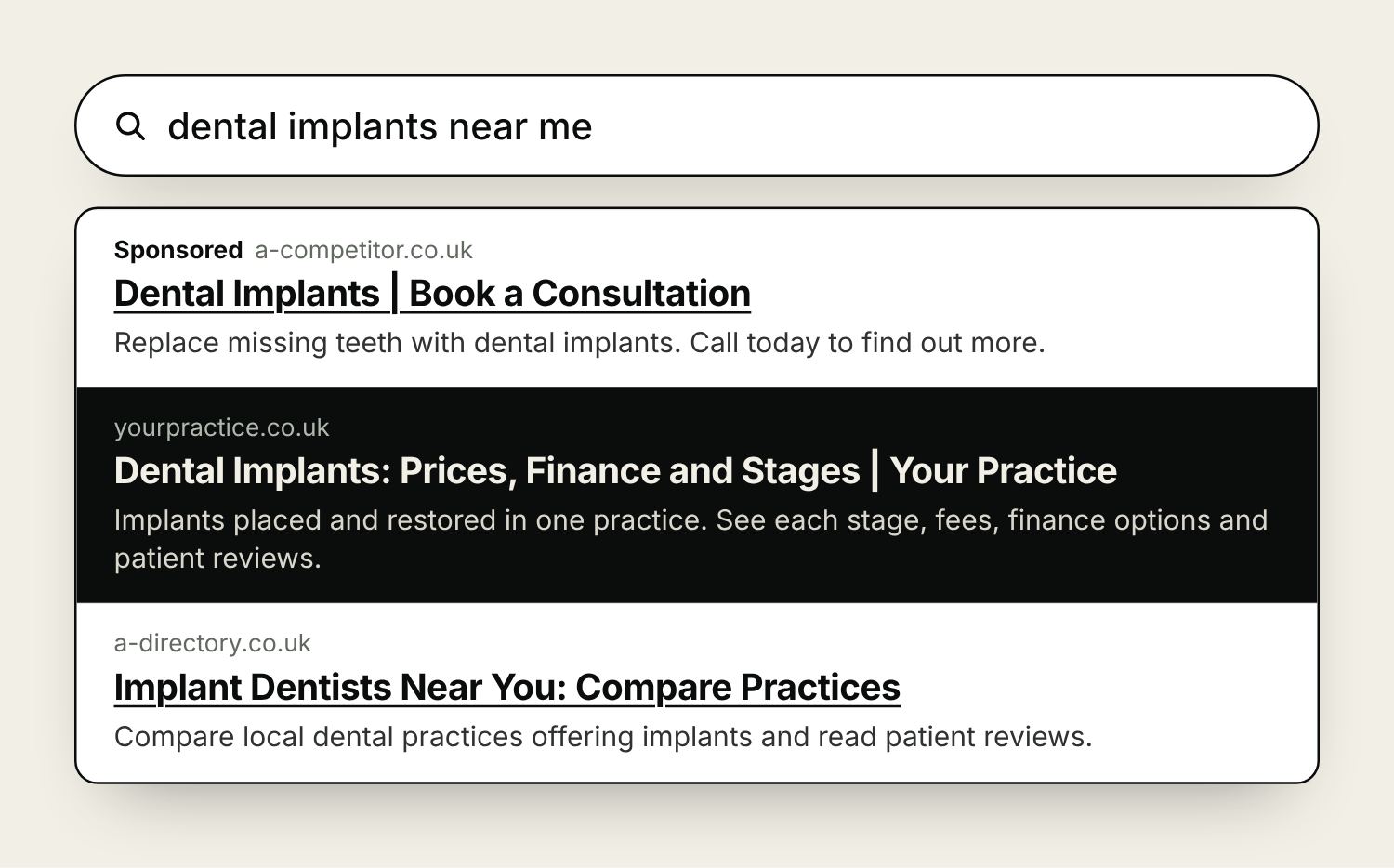
People searching “dental implants cost” or “emergency dentist” plus a town are ready to act. Google Ads put you in front of them straight away, and with call and form tracking you can see the cost per enquiry against the figure you set above. Start with one or two treatments, a tight area around the practice, and a separate campaign for each so you can see what each one costs.
4. Your existing patients
Your patient list is usually the cheapest source of whitening, aligner and membership sign-ups. People who already trust you are more likely to ask. Use the waiting room, the recall appointment and follow-up messages to mention treatments that suit them. Check consent before sending marketing emails or texts: appointment reminders are service messages, but promotions are marketing and need consent, or the “soft opt-in” for existing customers who were given a clear chance to opt out.
5. Local SEO and content
Over time, treatment pages that answer the questions patients ask (how long implants last, whether aligners hurt, what happens at a first visit for nervous patients) will start to bring in searches without ad spend. This takes months, so start it at the same time as the ads.
6. Social media and paid social
Social tends to suit aligners, whitening and showing what the practice is like more than implants, which patients research over a longer period. Show the team, the practice and patient stories, with consent. Paid social on Facebook and Instagram can reach local people who aren’t searching yet, but the rules on before-and-after images and on aesthetics treatments apply in full, so plan the content carefully.
The rules your dental marketing has to follow
This section covers the main points in general terms. It isn’t legal advice: check the current GDC guidance on advertising and the CAP code yourself, and ask your indemnity provider if you’re unsure.
GDC guidance on advertising
- Advertising must be legal, decent, honest and truthful, and must not mislead. The GDC expects dental professionals to follow the advertising codes as well as its own standards.
- For each dental professional named on your website, show their professional qualification, the country it comes from and their GDC registration number.
- The practice website must also show the practice name and address, a phone number and email address, the GDC’s contact details or a link to its website, your complaints procedure and who patients can go to if they’re unhappy with your response (the relevant NHS body for NHS treatment, the Dental Complaints Service for private treatment), and the date the site was last updated.
- Only a dentist on one of the GDC’s specialist lists can be described as a specialist. Avoid wording that suggests specialist status for anyone who isn’t on a list, such as calling a general dentist with an interest in implants an “implant specialist”. A dentist who isn’t on a list can say they have a “special interest in” an area or are “experienced in” it.
- Give patients clear information about treatment options and costs. Don’t put pressure on people to choose private treatment.
The advertising code (CAP), enforced by the ASA
- Have evidence for any claim you make. Avoid claims you can’t prove, such as “pain-free”, “guaranteed results” or “the best dentist in town”.
- A “from” price should be one that patients can genuinely get. Offers with a deadline must really end on that date.
- Before-and-after photos must be real patients who had the treatment you’re advertising, photographed in similar conditions, and not edited in a way that changes the result. Don’t present stock or manufacturer images as your own work, and don’t suggest every patient will get the same result.
- Testimonials must be genuine, and you should keep a record that shows they are.
Patient consent, testimonials and reviews
- Get a patient’s written consent before using their photos, video, name or story in marketing. Consent for clinical photos in their records is separate. Keep the consent with their record and remove the content if they withdraw it.
- When you reply to online reviews, don’t confirm that the person is a patient or discuss their treatment. Thank them, or invite them to contact the practice directly.
- Don’t offer discounts, prizes or other rewards in return for reviews. Google’s policies don’t allow it.
Prescription-only medicines and facial aesthetics
Prescription-only medicines cannot be advertised to the public in the UK. That includes botulinum toxin, so you can’t promote Botox, or the injections by another name, in ads, social posts or on your website. You can promote a consultation with a qualified prescriber about facial concerns, as long as it doesn’t name or point to the medicine. Indirect references count too: the ASA treats hashtags, nicknames such as “Beautox”, and promoting “anti-wrinkle” injections separately from fillers as advertising the medicine. Have any aesthetics copy checked before it goes live.
NHS and private messaging
In a mixed practice, be clear about which treatments are NHS and which are private, and whether you’re taking new NHS patients. Don’t run down NHS care to sell private treatment. If you’re in England, keep your listing on the NHS website up to date so patients aren’t told you have NHS places when you don’t.
CQC and finance
In England, dental practices are registered with and inspected by the CQC; the other UK nations have their own regulators. You can say you’re registered, but don’t present registration as an award or endorsement. If you advertise finance, that’s a financial promotion under FCA rules: use the wording your finance provider gives you, including any representative example it says you need.
Example: an invented practice’s one-page plan
Example: an invented mixed NHS and private practice with four surgeries in a market town. It has a closed NHS adult list, one dentist who places implants, and two who offer clear aligners. The owner wants more implant and aligner cases and more private membership sign-ups. All figures are examples.
| Plan line | What the invented practice wrote |
|---|---|
| Who we want | Adults within about 20 minutes’ drive who are missing teeth or unhappy with their smile, and local families who can’t find an NHS dentist. |
| How they choose | Reviews, a clear price, finance for implants, evening appointments, and how they’re treated if they’re nervous. |
| Why us | Implants placed and restored in one practice by the same dentist, fixed prices that include reviews, and appointments until 7pm twice a week. |
| Numbers | Up to £100 per implant consultation and £40 per aligner consultation. Target: 8 implant and 10 aligner consultations a month. |
| Channels | Google Business Profile and a review request after every appointment. New implant, aligner and membership pages. Google Ads on implant searches, then aligners. A membership offer to private patients at recall. |
| Rules | Registration details on every clinician’s profile, consent forms for any patient photos, no “specialist” wording, finance wording from the provider. |
| Measures | Consultations booked and treatments started by source, cost per consultation, reviews per month, membership sign-ups. |
Your first 90 days, in order
| When | Focus | Actions |
|---|---|---|
| Weeks 1 to 4 | Foundations | Write the one-page plan. Work out case values and what you can pay per consultation. Check the website and Google profile against GDC guidance and the CAP code. Set up call tracking, form tracking and a “how did you hear about us” field in your booking process. Start asking every patient for a review. |
| Weeks 5 to 8 | Pages and first ads | Rewrite the pages for your first two priority treatments, with prices, finance and a clear booking route. Set up consent forms for photos and testimonials. Launch Google Ads for one treatment in a tight area. Train reception on handling and logging treatment enquiries. |
| Weeks 9 to 12 | Existing patients and review | Run an in-practice and email campaign to consenting patients for whitening, aligners or membership. Add the second treatment to Google Ads if the first is within budget. Review consultations, treatment starts and cost per case by source, then write the next 90 days. |
If you’d rather have someone work through this with you, our marketing strategy service covers who you sell to, what’s working now and what to do first. For the ads themselves, see our Google Ads management.
How to measure your dental marketing
Check these monthly, by treatment and by source:
- Enquiries (calls, forms, online bookings) and where they came from.
- Consultations booked and attended.
- Treatment starts, and the share of consultations that go ahead.
- Cost per consultation and cost per treatment start from paid channels, against the limits in your plan.
- New private patients and membership sign-ups.
- New Google reviews and your average rating.
If reception doesn’t record where each patient came from, you can’t tell which marketing paid for itself. Fix that before you increase any budget.
What to ask an agency
Ask how they’ll check your ads and pages against GDC guidance and the CAP code, and who signs off before anything goes live. Ask whether they’ll report on consultations and treatment starts or only on clicks and leads, and how they’ll connect ad data to your booking records. Ask what they’ll need from your team each month, and what happens to your ad account and website if you part ways.
Frequently asked questions
How much should a dental practice spend on marketing?
Work it out from your own numbers rather than a percentage of turnover. Calculate the profit from each treatment case, decide what share you’ll spend to win one, and use your consultation and treatment rates to find the most you can pay per enquiry. Multiply by the number of cases you want.
What is the best marketing strategy for a dental practice?
For most independent practices: a complete Google Business Profile with a steady flow of reviews, clear treatment pages with prices and finance, Google Ads on the treatment searches you want more of, and campaigns to existing patients. Add SEO and social once those are working.
Can dentists use before-and-after photos in adverts?
Yes, if they are real patients who had the treatment advertised, gave written consent, and were photographed in similar conditions without editing that changes the result. Don’t use stock or manufacturer images as if they were your own work, and don’t imply every patient will get the same result.
Can a dental practice advertise Botox?
No. Botulinum toxin is a prescription-only medicine, and those can’t be advertised to the public in the UK. You can promote a consultation about facial concerns with a qualified prescriber, provided the ad doesn’t name or point to the medicine.
Can a dentist call themselves an implant specialist?
Only dentists on one of the GDC’s specialist lists can be described as specialists, and implant dentistry isn’t one of those lists. A general dentist can describe their training and experience in implants accurately, without using “specialist” or wording that implies it.
How do dental practices get more implant patients?
Make the implant page answer the questions patients research: who does the treatment, each stage, how long it takes, a clear starting price and finance. Then run Google Ads on implant searches near the practice, collect reviews from implant patients, and follow up every consultation that doesn’t book.

Founder of The Pursuit Agency in Swindon. He has worked in SEO for fifteen-odd years and leads the agency's SEO and Google Ads work for owner-led businesses across the UK.