
The short version
- Local SEO gets you into the map results and local listings when people nearby search for what you do. Those people are usually ready to call, visit or book.
- Google says it ranks local results on relevance, distance and prominence. You can’t change distance, so work on the other two.
- Your Google Business Profile and your reviews do most of the work, and both are free.
- Back the profile up with a page for each service on your website and the same business details on every directory.
- Measure calls, direction requests and enquiries as well as rankings.
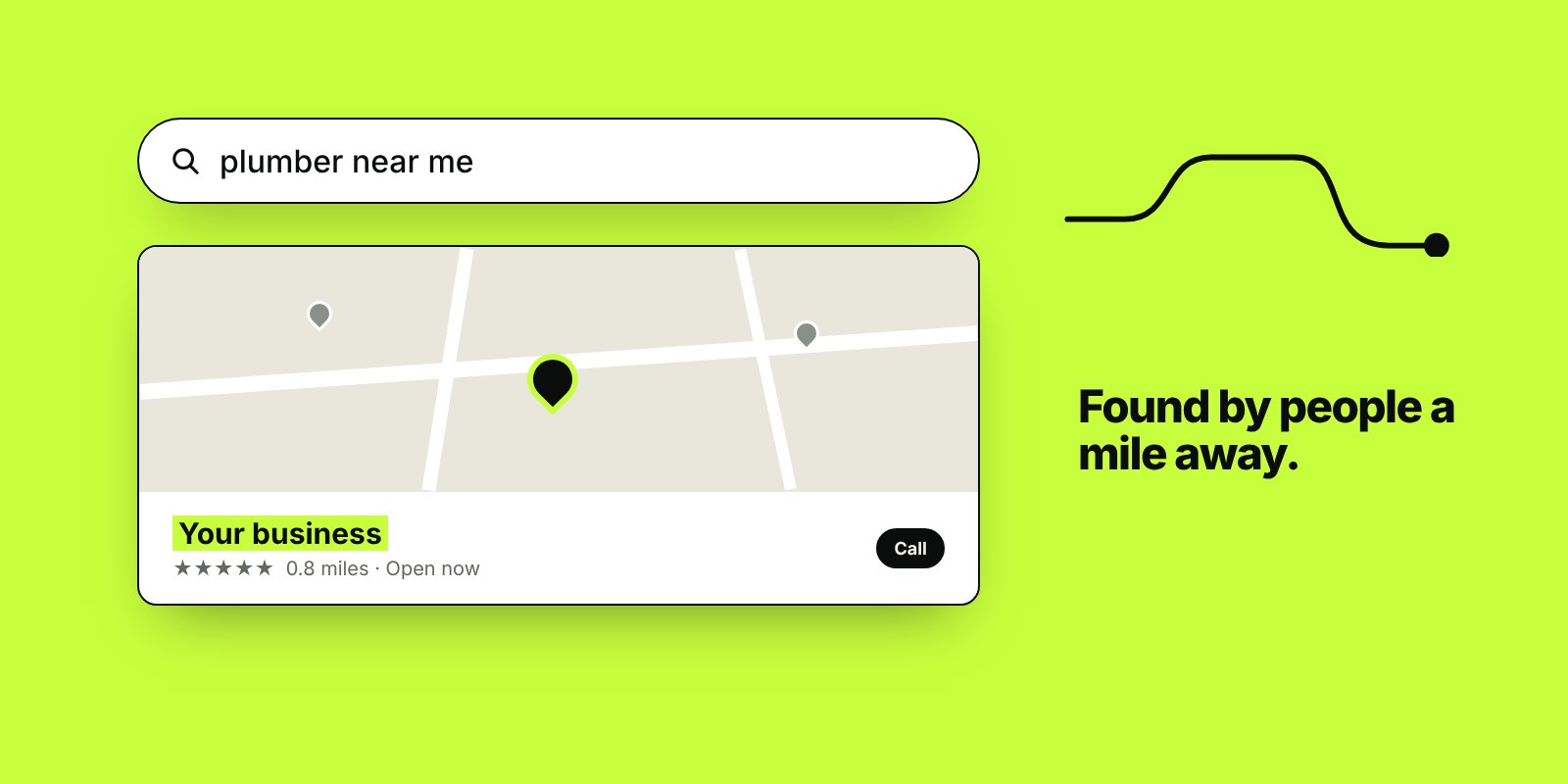
Local SEO is the work that gets your business found when someone nearby searches for what you sell: “electrician Swindon”, “dentist near me”, “coffee shop open now”. It’s important because those people need something now, and they’re likely to contact one of the handful of businesses Google shows them first.
Most of it is free and within your control. The rest takes steady effort over a few months.
What local SEO is
When Google decides a search has local intent, it usually shows a map with a short list of businesses, often called the local pack, and the same businesses appear in Google Maps. Local SEO covers both halves: getting into those map listings through your Google Business Profile, and getting your website to rank in the ordinary results for searches that include your town or “near me”.
It differs from general SEO because location decides so much. A plumber in Swindon isn’t competing with plumbers in Leeds, only with the ones Google considers relevant and close to the person searching.
Why local SEO is important
Local searchers are ready to act
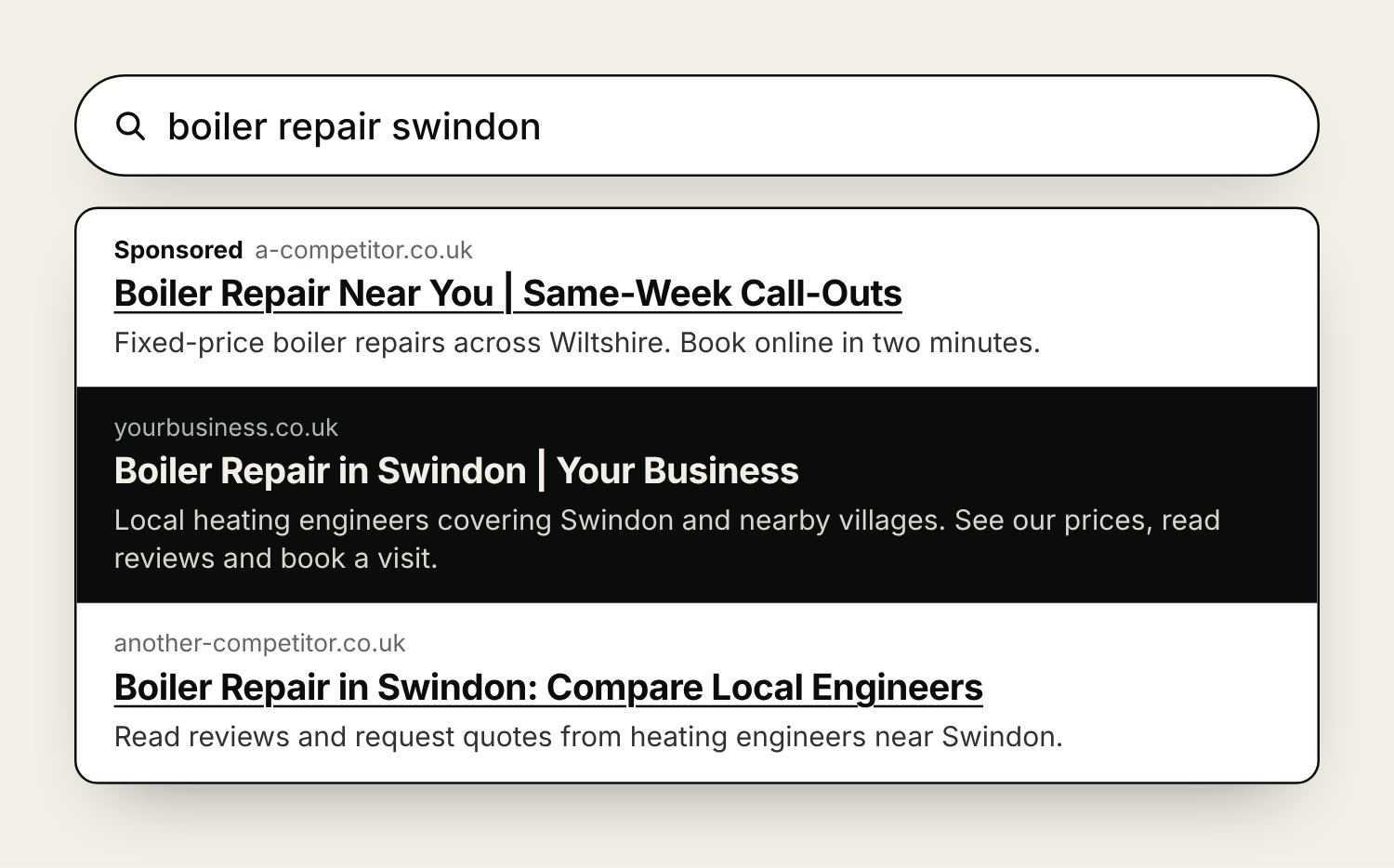
Someone searching “boiler repair Swindon” wants a boiler repaired, usually soon. Compare that with an advert shown to people who weren’t looking for anything. That intent is why enquiries from local search tend to turn into work.
The map results come first
For many local searches, the map listings appear before the first ordinary result, and on a phone they can fill the screen. If you aren’t in them, many searchers will never scroll far enough to find you.
The clicks are free
Calls, website visits and direction requests from your Business Profile and organic listings cost nothing per click. Getting there takes time and effort, but each improvement keeps working after you’ve made it, where an ad stops when the budget does.
Reviews decide who gets the call
Your star rating and recent reviews sit right next to your competitors’. A business with plenty of recent reviews, each with a sensible reply, looks like the safer choice. Google also says the number of reviews and your rating are factored into local ranking.
Small businesses can win
Local results reward being relevant and nearby, so a well-run independent business can appear above a national chain in its own area.
How Google decides local rankings
Google says local results are based mainly on three things. Here’s what each means in practice.
| Factor | What Google looks at | What you can do |
|---|---|---|
| Relevance | How well your profile and website match the search | Choose the right categories, list every service and write a page for each one |
| Distance | How far you are from the searcher, or from the place named in the search | Very little. Make sure your address or service area is accurate |
| Prominence | How well known and trusted you are, online and off | Earn reviews, links, mentions and local press, and keep your profile active |
Google also says your position in its ordinary web results feeds into prominence, so the SEO on your website helps your map ranking too.
Some tactics backfire. Adding keywords or a town name to your business name on the profile breaks Google’s guidelines and can get the profile suspended.
Local SEO checklist
1. Claim and complete your Google Business Profile
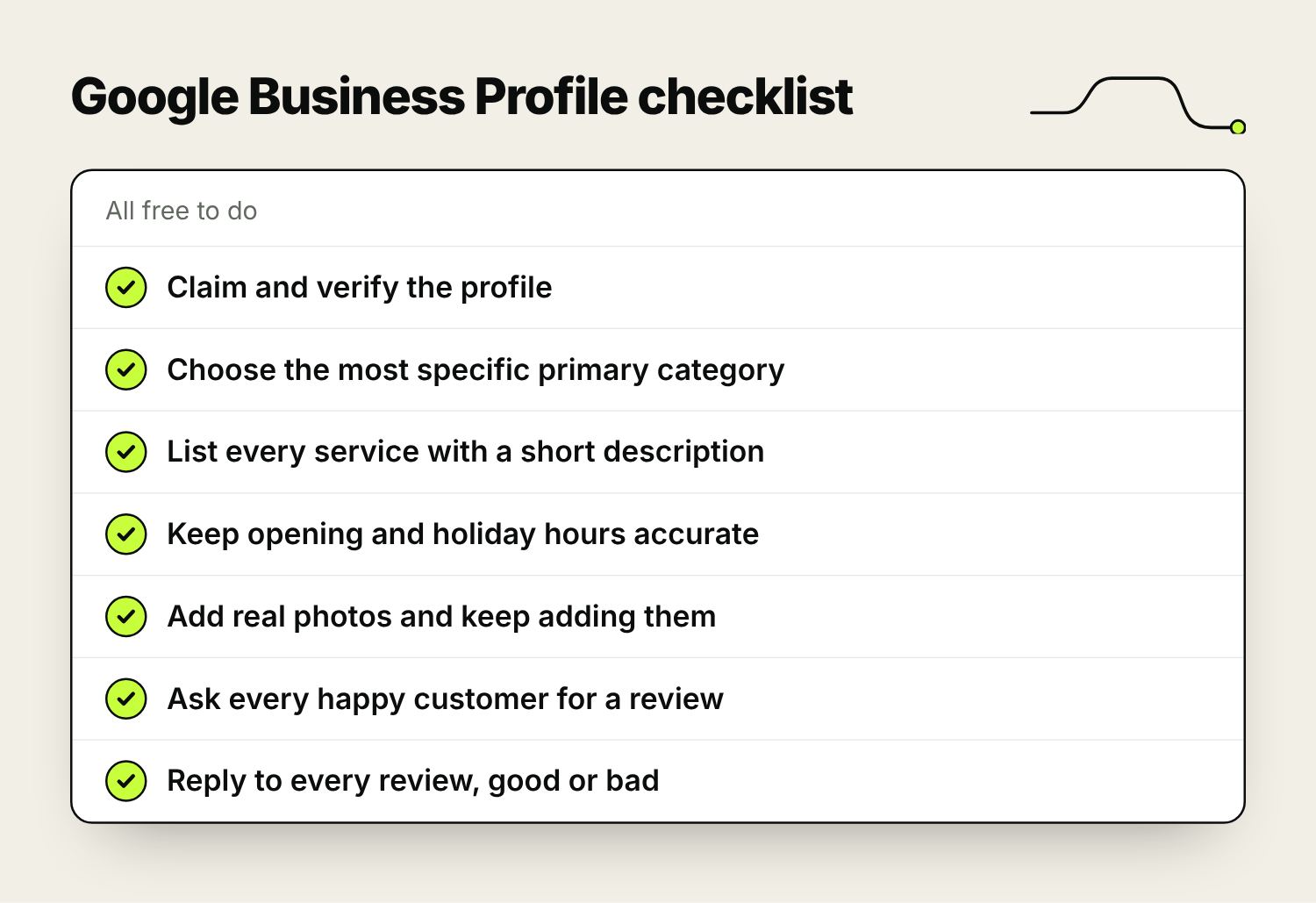
Claim and verify your profile if you haven’t already (it used to be called Google My Business). Then fill in every section:
- The primary category: the most specific one that describes your main service. Choose it carefully, because it shapes which searches you appear for.
- Secondary categories for your other genuine services, plus a full list of services with short descriptions.
- Opening hours, including bank holiday and other special hours.
- Photos of your premises, your work, your team and your vans, added regularly.
- A plain description of what you do, where and for whom.
- Posts for offers, news and events.
If customers don’t come to you, set the profile up as a service-area business: hide your address and list the towns or areas you cover.
2. Build a steady flow of reviews
Ask every satisfied customer at the moment they’re happiest: when the job’s finished, the order arrives or they thank you. Send a direct review link by text or email, or print a QR code on receipts and invoices. Reply to every review, thank people by name, and answer complaints calmly with an offer to put things right. Future customers read your replies as closely as the reviews.
Don’t buy reviews, write your own or offer rewards in return for them. Google’s policies ban it, and UK consumer law bans fake reviews.
3. Give each service its own page
Your website backs up your profile. Create a page for each main service that says what you do, where you do it, what it costs or how pricing works, with real photos and reviews. Use the words customers search with: “emergency plumber”, not “reactive plumbing solutions”.
If you cover several towns, write a location page only where you have something specific to say about that place, such as jobs you’ve done there, how quickly you can get there or local details. Dozens of near-identical pages with the town name swapped help nobody, and Google can treat them as spam.
Show your business name, address and phone number on every page (the footer is fine), make the number tap-to-call on mobile, and link your profile to the most relevant page. LocalBusiness schema markup helps Google read those details.
4. Keep your details consistent across directories
Citations are mentions of your business name, address and phone number on other websites. Make sure they match your profile exactly, especially after a move or a change of number. Start with the listings people use: Bing Places, Apple Business Connect (for Apple Maps), Facebook, Yell and the directories for your trade or industry. Getting the main ones right matters more than the number of listings.
5. Earn local links and mentions
Links from local websites tell Google you’re part of the area. Most come from things you already do or easily could: sponsoring a club or event, supplier and partner websites, the local chamber of commerce, charity work, a story in the local paper, a guest piece for a community site.
Partnerships work offline as well. Neighbouring businesses that share your customers can recommend you, run joint offers with you and link to your site from theirs.
6. Create local content worth finding
Good local content is specific: a guide to typical costs in your area, write-ups of recent jobs by area (leave client names out unless they’re happy to be named), answers to the questions people ask on the phone, and your part in local events. It gives people a reason to trust you and gives Google more to go on.
Short videos help here. A walk-through of a finished job, a quick answer to a common question or a look behind the scenes can go on your Business Profile, YouTube and social media. A phone and decent light are enough to start with.
7. Make sure the site works on a phone
Many local searches happen on a phone, often on the move. Your site should load quickly, show your phone number and location without scrolling, and let people call, book or get directions with one tap.
Local SEO for shops and high street businesses
If people visit you in person, your Business Profile does much of the job a shop window does. Keep opening hours exact, because wrong hours on Google send people to a locked door. Add photos of the shopfront so people recognise it from the street, fill in attributes such as accessibility and payment options, and add your products where the profile allows it.
Then give people reasons to come in and talk about you: in-store events, a loyalty card, joint promotions with neighbouring shops, a stall at local markets and festivals. Post each one on your profile and social media, and ask customers who enjoyed it to leave a review.
Local advertising alongside local SEO
Local SEO takes time. Advertising can bring in enquiries while it builds, and covers searches you don’t rank for yet.
The local advertising options most small businesses consider, and how to tell whether each one works.
| Channel | Best for | How to measure it |
|---|---|---|
| Google Ads targeted to your area | Services people search for urgently, such as repairs and emergency call-outs | Call tracking and form conversions in Google Ads and GA4 |
| Facebook and Instagram ads to a set radius | Things people buy on sight: food, beauty, retail, events, home improvements | Messages, bookings and a tracked landing page |
| Local print: magazines, newspapers, leaflets | Very local services and older audiences | A unique phone number, offer code or web address |
| Outdoor: signage, vans, banners, posters | Repeated visibility on the routes your customers use | Hard to track, so ask every new customer how they found you |
| Sponsorship and community events | Familiarity and goodwill in a community | Ask new customers, and track any event-only offer |
Whichever you choose, keep your business name, offer and look consistent with your profile and website, so someone who sees your van or a leaflet and then searches for you recognises what they find. Our guide to marketing ideas for small businesses covers Google Ads and Facebook and Instagram ads in more detail, and our Google Ads management service runs local campaigns.
How to measure local SEO
- Business Profile performance: calls, website clicks, direction requests and the searches that found you, month by month.
- Google Search Console: clicks and impressions for searches that include your town or “near me”.
- Map rankings from several points: they change from street to street, so check from different places across your area.
- Enquiries and sales: ask every new customer how they found you, and track calls and forms from the website.
Our post on monitoring search engine rankings covers tools and methods.
How long local SEO takes
Fixing an incomplete or wrongly categorised Business Profile can make a difference within weeks. Reviews, links, content and service pages build over months, and competitive trades in bigger towns take longer. Give it three to six months of steady work before you judge it. There’s more on timescales in how long does SEO take. If you’d rather hand the work over, our local SEO service covers everything in the checklist above.
Frequently asked questions
Why is local SEO important for small businesses?
People searching for a local service usually want it soon, and they tend to contact one of the few businesses Google shows them first in the map results. Local SEO is how you get into that list. The clicks are free, and a well-run independent business can appear above national chains in its own area.
What is the difference between local SEO and SEO?
General SEO is about ranking your website in the ordinary results, often against competitors anywhere in the country. Local SEO adds the map results and Google Maps, where your Google Business Profile, your reviews and how close you are to the searcher matter as much as your website.
How do I get my business into the Google map results?
Claim and verify your Google Business Profile, choose the most accurate primary category, fill in every section, and build a steady flow of reviews that you reply to. Back it up with a page on your website for each service and consistent business details across directories. Distance to the searcher also counts, and that part you can’t change.
Do I need a physical address for local SEO?
You need a genuine address to verify a Google Business Profile, but if customers don’t visit you, you can hide it and show the towns or areas you serve instead. Google doesn’t accept PO boxes as a business address.
How long does local SEO take?
Fixing an incomplete or wrongly categorised Business Profile can make a difference within weeks. Reviews, links and website content build over months, and competitive trades in bigger towns take longer. Give it three to six months of steady work before judging it.
How much does local SEO cost?
Much of it you can do yourself for nothing but time: the Business Profile, reviews and directory listings are free. If you’d like help, Pursuit’s local SEO work starts from £1,000 a month on 3-month rolling or 12-month terms.

Founder of The Pursuit Agency in Swindon. He has worked in SEO for fifteen-odd years and leads the agency's SEO and Google Ads work for owner-led businesses across the UK.