
The short version
- Expect the first signs in Search Console within about three months, and steadier enquiries somewhere between six and twelve months. Competitive national searches can take longer.
- Fixing indexing problems and improving pages already sitting on page two usually pays back fastest.
- New pages and links for competitive searches are the slow part, and they keep paying back once they work.
- Publish good content as soon as it’s ready. Google doesn’t reward drip-feeding it.
- Judge progress in this order: impressions, then clicks from non-brand searches, then enquiries. Rankings on a single day tell you very little.
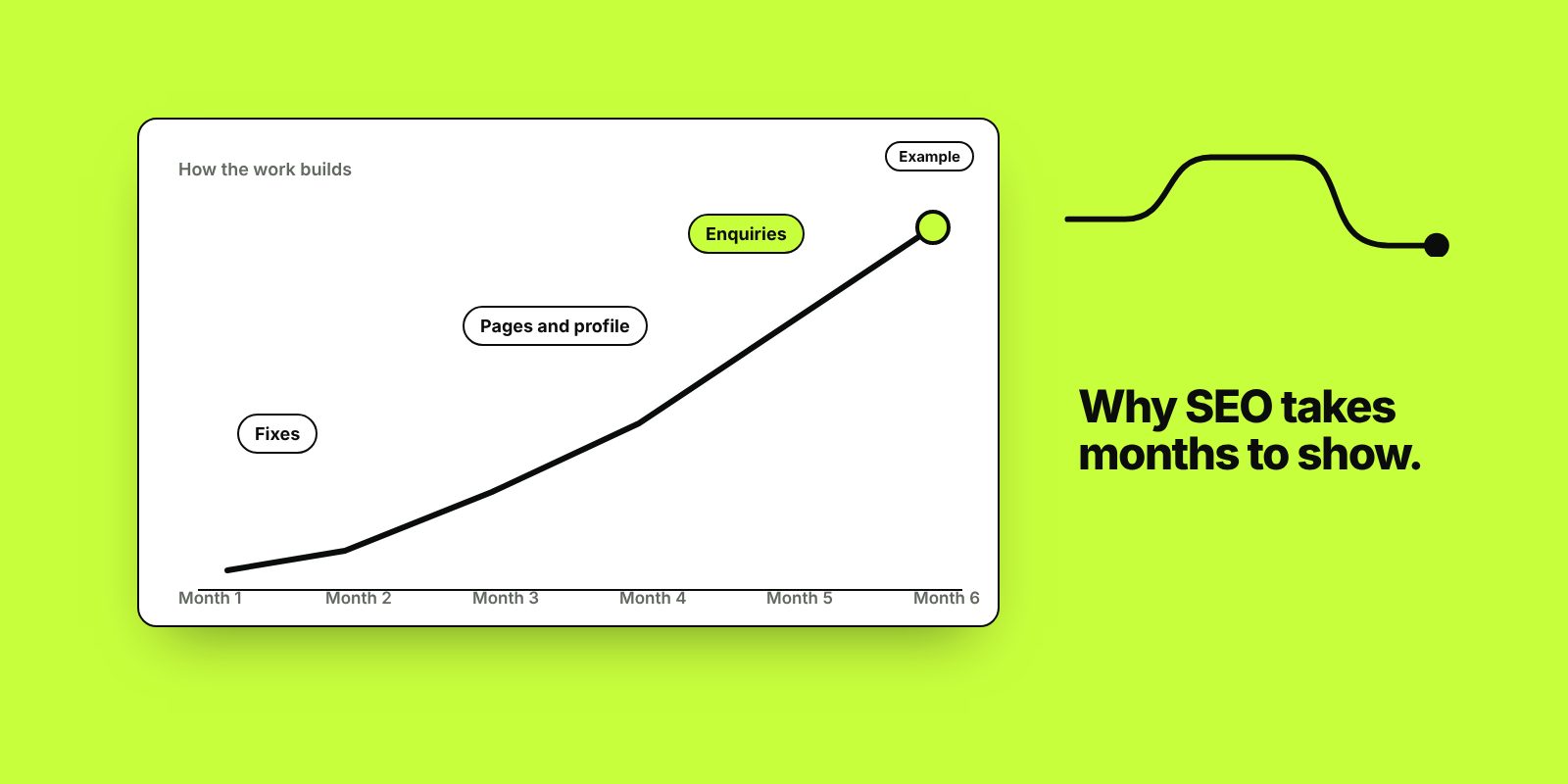
Most SEO work takes months to turn into enquiries. Google’s own guidance for businesses hiring an SEO says it usually takes four months to a year to make the improvements and start seeing the benefit. That fits what we see with owner-led businesses: Search Console data starts to move within weeks, and the phone follows later.
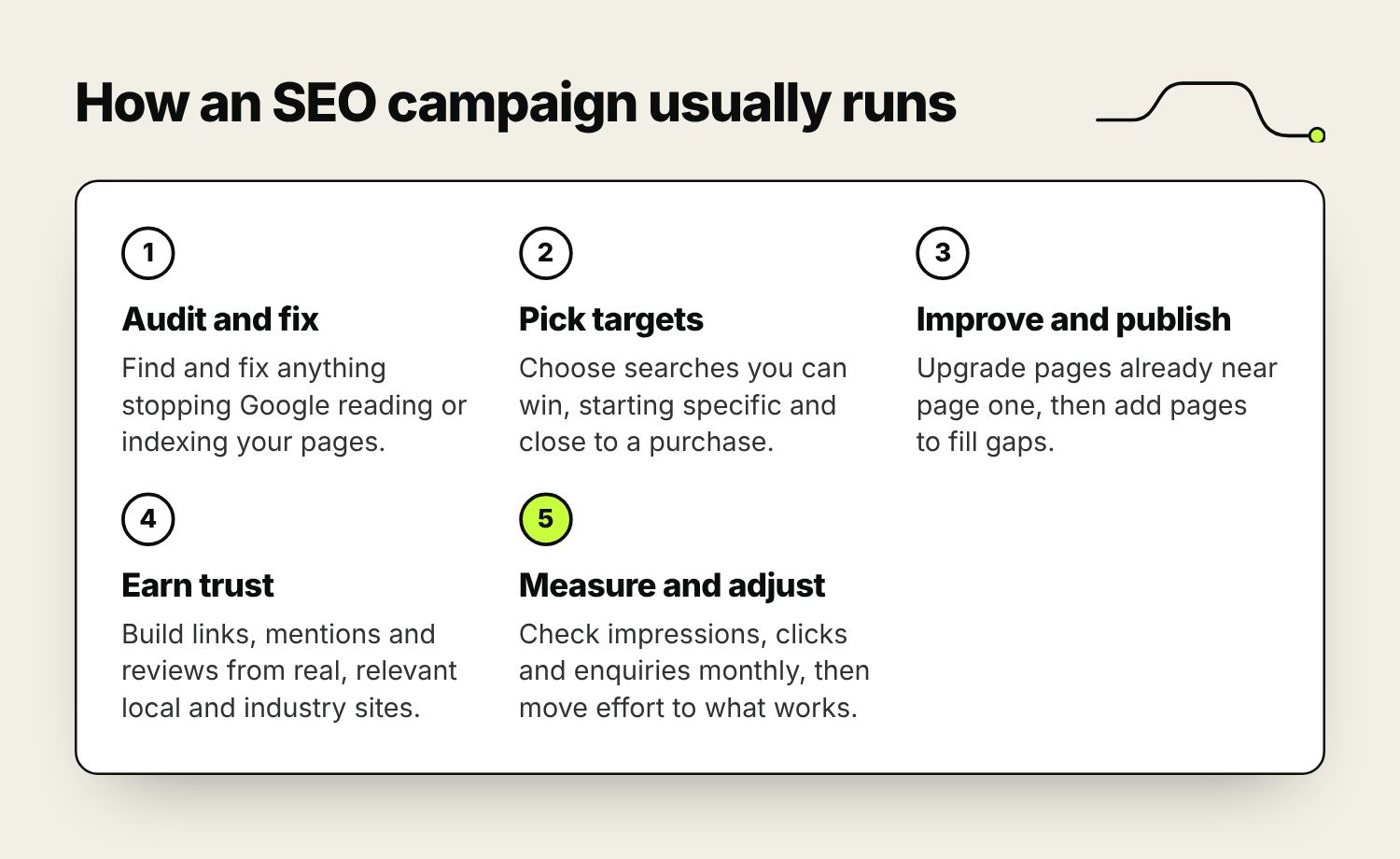
Where your business lands in that range depends on three things: the state of your site when you start, how competitive your searches are, and how much work gets live each month. This guide sets out a realistic timeline, what speeds it up or slows it down, and how to tell it’s working before the enquiries arrive.
How long SEO takes: a realistic timeline
Typical for a small or medium UK business website with no penalties or serious technical faults. Yours will vary.
| Period | What usually happens | What you should see |
|---|---|---|
| First month | Audit, technical fixes, tracking set up, priorities agreed | Fixes live; Search Console and GA4 reporting correctly |
| Months 1 to 3 | Existing pages improved, Google Business Profile tidied, first new pages published | More impressions in Search Console; some pages moving up from page two |
| Months 3 to 6 | New pages start ranking for specific, less competitive searches; links and reviews build | More clicks from searches that don’t include your name; first enquiries you can trace to organic search |
| Months 6 to 12 | Pages start competing for broader searches | Steadier organic enquiries and a clear view of which pages bring work in |
| Year two onwards | More pages ranking, more links, more trust | Organic search becomes a dependable source of new business |
Local searches such as “electrician Swindon” often move faster than national ones, because you’re up against a few dozen local firms instead of every site in the country. A brand new website usually takes longer than an established one that has been neglected, mainly because Google has no links or history to go on.
What makes SEO faster or slower
Where your site starts
A site with years of history, some links from other sites and pages Google already indexes has a head start. A new domain starts close to zero. So does a site that was rebuilt without redirecting the old page addresses to the new ones, which is one of the most common reasons we see for traffic falling off a cliff after a relaunch. If that’s happened to you, fix the redirects before anything else.
How competitive your searches are
Search for the phrases you want to win and look at page one. If it’s national brands, comparison sites and directories, a small business will take a long time to break in, and will usually do better starting with more specific searches: a service plus a town, or a particular product type. If page one is other local firms with thin websites, progress can come quickly.
How much work goes live, and how fast
Progress follows the amount of work that reaches the site. A plan that waits six weeks for sign-off or for a developer is six weeks slower. The campaigns that move fastest have someone in the business who can answer questions, approve pages and supply photos and detail within a few days.
Whether the content helps the person searching
Pages rank when they answer the search better than the alternatives. There’s no minimum or ideal word count: a page needs to be long enough to solve the visitor’s problem and no longer. A hundred cheap 300-word articles won’t move your rankings. Ten pages that show you know the job, with real prices, photos, process and answers to the questions customers ask on the phone, often will.
Google’s helpful content update in 2022 went after sites with a lot of content written mainly to rank. Google has since folded that into its core ranking systems, so the principle applies all the time. Its published self-assessment questions are worth running against your own pages. The ones that matter most for a small business: would an existing customer find this page useful if they landed on it directly? Does it show first-hand experience of doing the work? Would someone leave feeling they’d found what they came for?
Quick wins and slow work
Some SEO work shows results in weeks. Most of the long-term value comes from slower work that builds on itself.
| Work | How soon it tends to show | Why |
|---|---|---|
| Fixing indexing problems, such as pages blocked from Google or missing redirects | Days to weeks, once Google recrawls | Pages that couldn’t rank before now can |
| Rewriting page titles and descriptions on pages that already get impressions | Weeks | More clicks from the same positions |
| Improving pages sitting on page two | Weeks to a few months | They’re already close |
| Completing and updating your Google Business Profile | Weeks to months | Map results respond to complete, accurate profiles and steady reviews |
| New service, location or product pages | Months | Google has to find, test and trust them |
| Earning links and mentions from other sites | Months, and it keeps building | Trust accumulates slowly |
If your business depends on local customers, the map results deserve early attention. Our guide to local SEO covers what moves them.
Publish content all at once, or drip it out?
A long-running SEO myth says that publishing lots of pages at once looks unnatural to Google and hurts rankings. Adding several good pages in one go doesn’t count against a site. If they’re ready, put them live: the sooner Google can find them, the sooner they can start ranking.
A steady rhythm after that is still worth having. It keeps the site current, gives customers a reason to come back and gives you something to share by email and social.
Taking pages away can help too. Google has said that removing unhelpful content may help the rest of a site rank better. Once a year, list the pages that got no impressions in Search Console over the previous twelve months. Improve the ones that should matter, merge the ones that overlap, and remove or redirect the rest.
How many keywords should each page target?
There’s no rule that sets a number. Give each important page one main topic, which usually means one main search phrase plus the variations people use for the same thing. “Boiler repair Swindon”, “boiler repairs in Swindon” and “Swindon boiler engineer” can all be served by one page. “Boiler installation” needs its own page, because it’s a different job with different questions.
- Put the main phrase in the page title, the main heading and the first paragraph, written the way a customer would say it.
- Use related words naturally. Google understands synonyms, so you don’t need to repeat the exact phrase.
- Don’t build two pages for the same search. They compete with each other, and often both rank worse than one good page would.
- Start with longer, more specific searches, such as a service plus a town or a product plus a size. They’re usually easier to win and closer to a purchase.
- Ignore keyword density targets. No percentage helps.
How to tell SEO is working before rankings settle
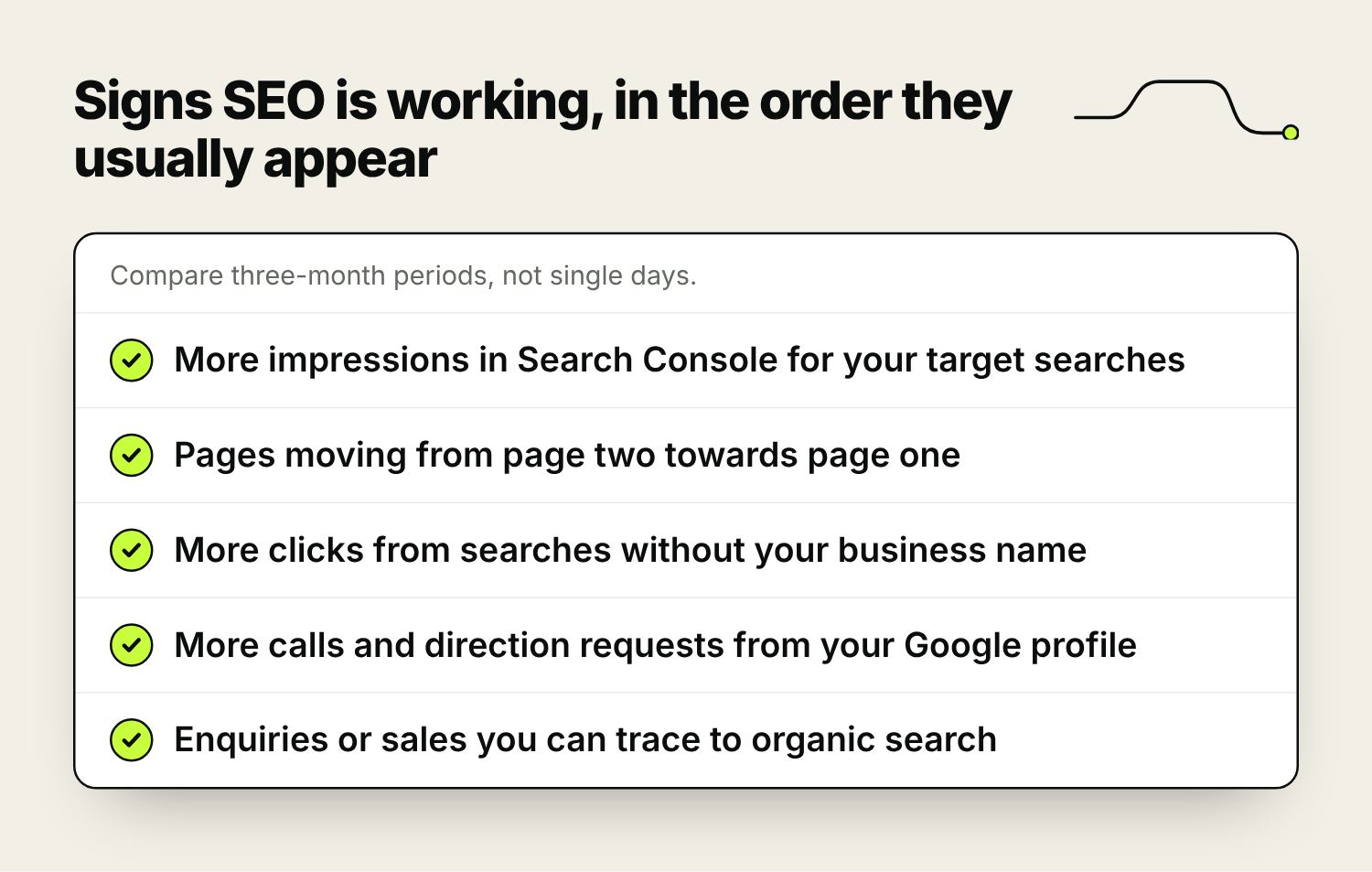
Rankings move around from day to day, especially for new pages. Look at trends over months instead, roughly in this order:
- Impressions in Search Console rise. Google is showing your pages for more searches, even if people aren’t clicking yet.
- Average position for your target searches improves over two or three months.
- Clicks from non-brand searches rise. These are searches that don’t include your business name, so they’re mostly new customers.
- Organic enquiries, calls or sales rise in GA4 and in your own records.
If impressions are flat after three or four months of real work, something needs investigating. The pages may not be indexed, the targets may be too competitive for now, or the content may not match what people searching want. Our guide to monitoring search engine rankings shows where to find each of these numbers.
Free tools for tracking SEO progress
You don’t need paid software to see whether SEO is working. These are free:
- Google Search Console: the searches you appear for, clicks, average position and any indexing problems.
- Google Analytics 4: what visitors from organic search do on the site, and how many enquire or buy.
- Google Business Profile: calls, direction requests and website clicks from your map listing.
- Bing Webmaster Tools: similar data for Bing.
- PageSpeed Insights: how quickly your pages load, with specific fixes.
- Keyword Planner, inside Google Ads: rough search volumes. You need a Google Ads account, but you don’t have to run ads.
None of these will bring visitors on their own, but between them they show you where to put the work.
How long should you commit to SEO?
Give a new SEO plan at least six months before judging it on enquiries, and judge it on the early signs above before that. If you need enquiries this month, run Google Ads alongside. Paid search can bring in leads from the day the ads are approved while SEO builds, and once you rank well for a search you can often reduce what you spend on it.
For reference, our SEO starts from £1,000 a month on a 3-month rolling or 12-month term. A rolling term means you can stop if it clearly isn’t working, but expect to need more than one three-month block before enquiries show the full picture. Our pricing page explains the bands. If you’re comparing agencies and freelancers, these are the questions to ask before you hire anyone.
Frequently asked questions
How long does SEO take to work?
Most businesses see early signs in Search Console within about three months, and steadier enquiries from organic search between six and twelve months. Competitive national searches can take longer. Local searches and sites with existing history often move faster.
Can SEO work in a month?
Some fixes can show within weeks, especially indexing problems and better page titles on pages that already get impressions. A meaningful rise in enquiries usually takes months, because new pages and links take time to earn Google’s trust.
Why is my SEO taking so long?
The usual causes are pages that aren’t indexed, targets dominated by national brands, content that doesn’t match what people are searching for, too few links, or work waiting weeks for approval before it goes live. Search Console will show you which of these applies.
How many keywords should I use on a page?
Give each page one main topic: one main phrase plus the natural variations people use for the same thing. Put the main phrase in the title, the main heading and the opening paragraph. There’s no set number or keyword density to aim for.
Is it better to publish lots of content at once?
If the pages are good and ready, publish them. Google doesn’t penalise a site for adding several pages at once. A steady rhythm afterwards helps keep the site current for customers.
Does local SEO work faster than national SEO?
Often, yes. You’re competing with fewer businesses, and improvements to your Google Business Profile and local pages can show within weeks to a few months. Busy towns and crowded trades still take longer.

Founder of The Pursuit Agency in Swindon. He has worked in SEO for fifteen-odd years and leads the agency's SEO and Google Ads work for owner-led businesses across the UK.